 0 ITEMS IN CART

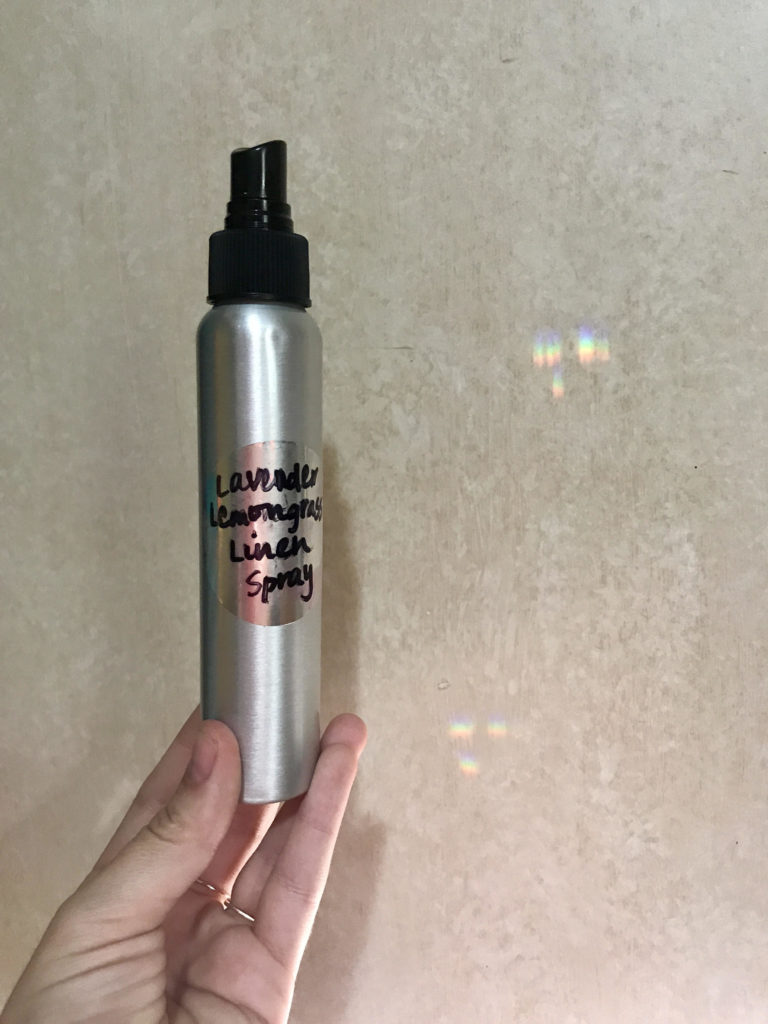
LAVENDAR LEMONGRASS LINEN SPRAY
09/27/17 — Heydon Hatcher
Recipe and Photos by Megan Winfrey
Lemongrass is one of the more special items offered by JBG, in my opinion. You may think that it's only useful in Thai dishes and soups, but I like to use it in a more holistic way. Steeping chopped lemongrass in boiling hot water for a few minutes makes a lovely hot tea, and infusing the lemony-citrus aroma into oil or water for cleaning, spritzing, and diffusing are both extremely beneficial ways to use this grassy plant. Packed full of antioxidant and antimicrobial properties, lemongrass has been shown to detoxify the body as well as build immunity. And as if you need another reason to make this spritz, it smells AMAZING and you'll be using it in every room of the house 24/7.
![]()
Lavender Lemongrass Linen Spray
Bring 1 cup of water to a boil. Add the chopped lemongrass and lavender buds, stir together. Cover, remove from heat, and let steep for 5 minutes.
Put a coffee filter into a funnel or strainer, and strain the liquid into a large mason jar or small pitcher.
![]()
Bring another 1 1/2 cups of water to a boil. Remove from heat and add to the herby mixture.
Add the vodka or witch hazel and stir or shake vigorously.
After the mixture has cooled to room temp, use a funnel to pour the mixture into a spray bottle.
You may leave any excess mixture in a closed mason jar to use as needed. Just shake well before using.
I spray this stuff on my sheets, couch, pillows, daughter's crib, rugs, into the air, and sometimes on my face. It smells that good.
![]()
Lemongrass is one of the more special items offered by JBG, in my opinion. You may think that it's only useful in Thai dishes and soups, but I like to use it in a more holistic way. Steeping chopped lemongrass in boiling hot water for a few minutes makes a lovely hot tea, and infusing the lemony-citrus aroma into oil or water for cleaning, spritzing, and diffusing are both extremely beneficial ways to use this grassy plant. Packed full of antioxidant and antimicrobial properties, lemongrass has been shown to detoxify the body as well as build immunity. And as if you need another reason to make this spritz, it smells AMAZING and you'll be using it in every room of the house 24/7.
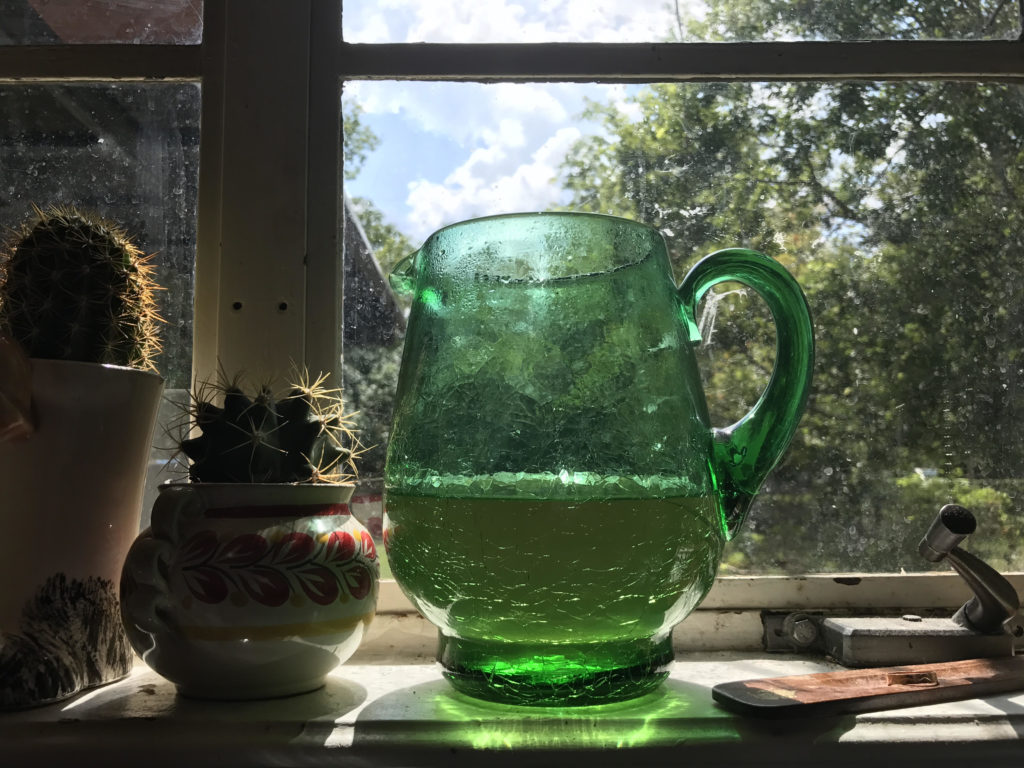
Lavender Lemongrass Linen Spray
- 1 bunch of lemongrass, cut into pieces (I used a 2-week old bunch and it was still full of aroma)
- 5 tbs. lavender buds
- 2 tbs. vodka or witch hazel
- 12 drops lavender essential oil
- 12 drops lemongrass essential oil
Bring 1 cup of water to a boil. Add the chopped lemongrass and lavender buds, stir together. Cover, remove from heat, and let steep for 5 minutes.
Put a coffee filter into a funnel or strainer, and strain the liquid into a large mason jar or small pitcher.
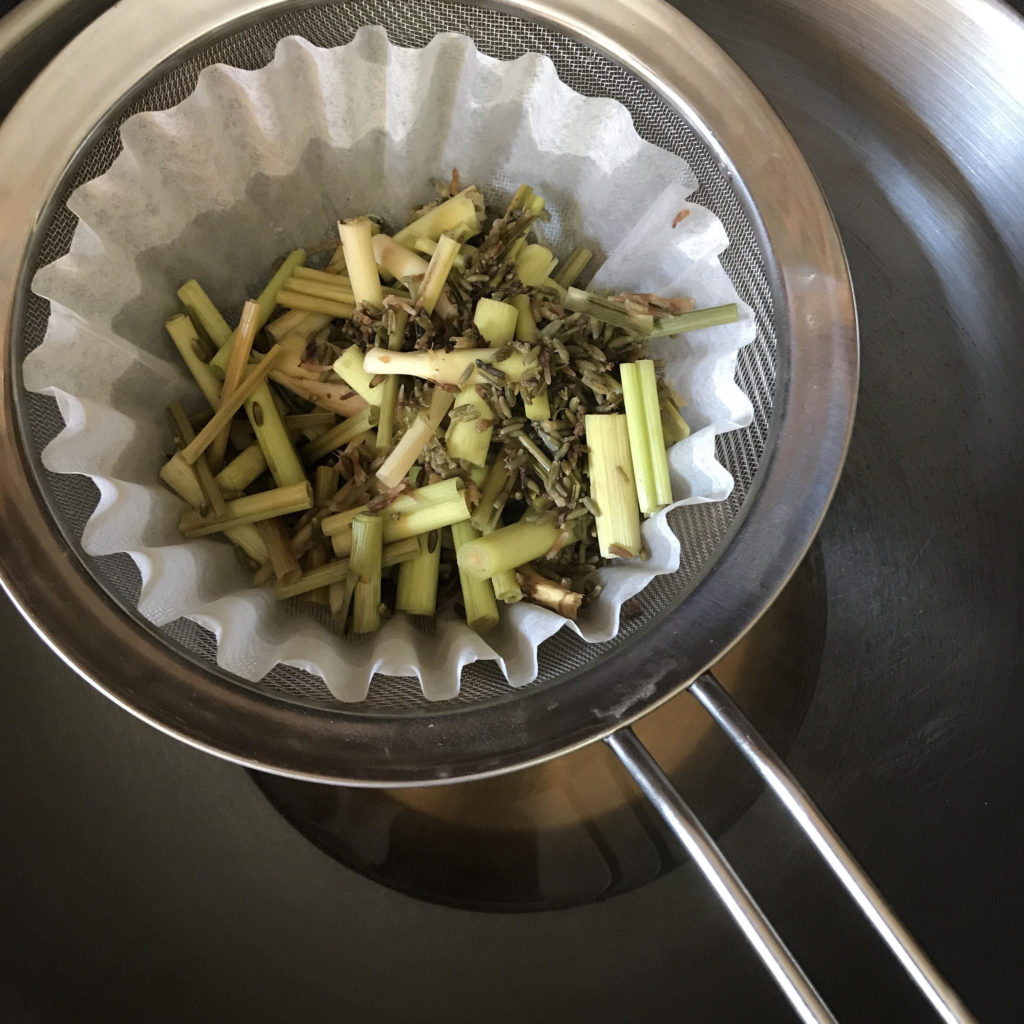
Bring another 1 1/2 cups of water to a boil. Remove from heat and add to the herby mixture.
Add the vodka or witch hazel and stir or shake vigorously.
After the mixture has cooled to room temp, use a funnel to pour the mixture into a spray bottle.
You may leave any excess mixture in a closed mason jar to use as needed. Just shake well before using.
I spray this stuff on my sheets, couch, pillows, daughter's crib, rugs, into the air, and sometimes on my face. It smells that good.
CSA BOX CONTENTS WEEK OF SEPT 25TH
09/26/17 — Scott
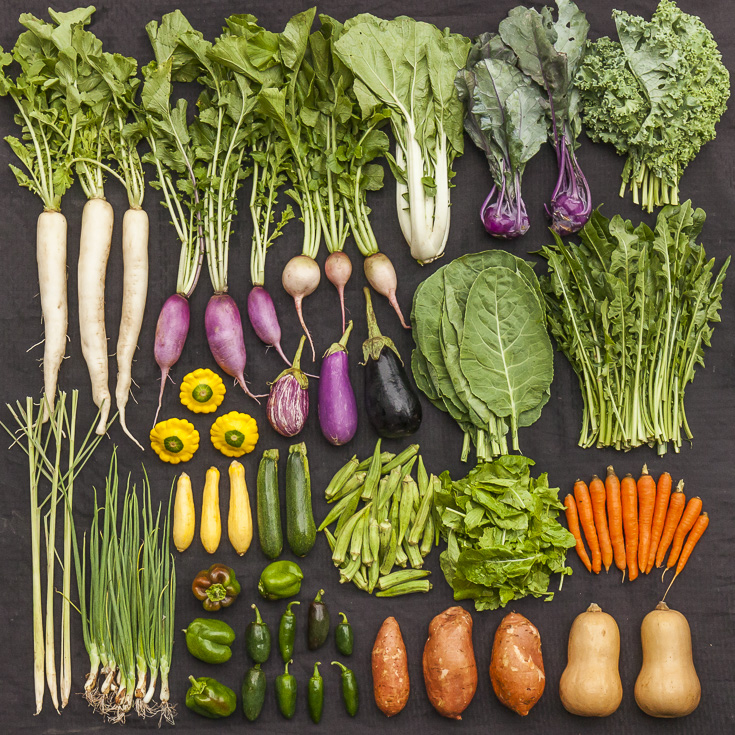 CSA Box Contents Week of Sept 25th
Large Box
Bok Choy
Carrot, Orange
Greens, Collards
Greens, Dandelion
Herb, Parsley, Flat
Lettuce, Braising Mix
Okra
Pepper, Serrano
Potato, Sweet
Radish, Green Daikon
Squash, Butternut
Squash, Farmer's Choice
Turnip, Scarlett
Bok Choy
Carrot, Orange
Greens, Collards
Greens, Dandelion
Herb, Parsley, Flat
Lettuce, Braising Mix
Okra
Pepper, Serrano
Potato, Sweet
Radish, Green Daikon
Squash, Butternut
Squash, Farmer's Choice
Turnip, Scarlett
Medium Box
Carrot, Orange
Eggplant, Medley
Greens, Collards
Greens, Kale, Curly
Herb, Parsley, Flat
Onion, Multiplying
Potato, Sweet
Radish, Black Spanish
Radish, Purple Daikon
Squash, Farmer's Choice
Carrot, Orange
Eggplant, Medley
Greens, Collards
Greens, Kale, Curly
Herb, Parsley, Flat
Onion, Multiplying
Potato, Sweet
Radish, Black Spanish
Radish, Purple Daikon
Squash, Farmer's Choice
Small Box
Beet, Red
Carrot, Orange
Greens, Arugula
Greens, Kale, Curly
Herb, Spearmint
Onion, Multiplying
Radish, Watermelon
Squash, Butternut
Beet, Red
Carrot, Orange
Greens, Arugula
Greens, Kale, Curly
Herb, Spearmint
Onion, Multiplying
Radish, Watermelon
Squash, Butternut
Individual Box
Eggplant, Medley
Greens, Collards
Herb, Lemongrass
Okra
Potato, Sweet
Squash, Farmer's Choice
Eggplant, Medley
Greens, Collards
Herb, Lemongrass
Okra
Potato, Sweet
Squash, Farmer's Choice
EMPLOYEE SPOTLIGHT: SCOTT DAVID GORDON, FARM PHOTOGRAPHER
09/22/17 — Heydon Hatcher
Time for another installment of one of our most favorite blog series: the Employee Spotlight! We hope that these interviews will help acquaint you with the folks on the farm who are largely responsible for keeping the delicious JBG vegetables rolling out, week after week (or in this case, photographs all the veggies).
This week, we are absolutely delighted to spotlight our staff photographer, Scott David Gordon. Over the past seven years, he’s captured everything from the worst weather disasters to the tiniest bee pollinating. His compositional eye is unparalleled in farm photography and we are elated that he has stuck with us for as long as he has. He travels from the farm to every farmers market to keep the farm community updated on all farm occurrences with an artistic flourish and for that we are endlessly grateful. We had the opportunity to venture to Scott’s studio in East Austin while he was in the midst of editing farm photographs to learn a little more about his life on and off the farm.
![]() Scott in his studio at Canopy.
Scott in his studio at Canopy.
Where did you grow up?
I lived in Joliet, Illinois until I was 10, and then moved here with my parents.
What brought you to JBG?
I wanted to find some healthy food options after moving back from New York City in 2010, so I was looking specifically for a CSA. I found the JBG CSA and joined. When I was picking up one day at the Hope Farmers Market (the old location), I met Brent. I didn’t have anything going on at the time, and I thought I would just ask him if I could come out and take pictures of the farm. Then I did… that was on September 23, 2010 (almost 7 years ago exactly!). Carrie Kenney worked at the farm at that time as the office manager. She did the blog and everything. She asked me if I wanted to start taking pictures every week and get veggies as a trade. That’s how it all started.
What’s your favorite thing about photographing the farm?
One thing is once a week, I know that I’m going to be outside all morning. I usually get to watch the sun rise and enjoy the outdoors. I catch some fresh air, walk around, interact with people that work at the farm, and see what’s going on. It’s not always easy to make time for a hike, so I think it’s kept me sane over the years getting to go to the farm every week. I do a lot of walking out there, typically around 3-4 miles. It’s good exercise. Get my hands in the dirt, work on my Spanish, and learn about farming.
How did you get into photography?
I guess it’s just something that interested me as a teenager. Right around the time I graduated from high school, I started using my dad’s film camera, shooting slide film and it just seemed kind of magical to me. I started taking pictures more, and it just started to seem like something that I could do with my life. I really enjoyed it from the beginning.
Did you study photography?
I studied at Austin Community College, they have one of the best photography programs in the country. It has more of a commercial program as opposed to a more Fine Art based curriculum.
What is the best vantage point to shoot from for farm photography?
Up high. I try to stand on a truck, tractor, or trailer to get a higher vantage point, a wider view, or a different angle.
What are your five favorite photos and why do you love them?
![]()
This picture of okra and sky was taken on my very first day on the farm. I like the simplicity and beauty of it and am often attracted to somewhat abstract or seemingly two dimensional scenes.
![]()
I’ve always loved the atmosphere of this image and the body language of the workers which almost suggest they are about to wander into the unknown.
![]()
The composition of this image really appeals to me and I like how Christian is dressed and his movement.
![]()
Color is also something I love. These are there different types of beans in the owner of the farm’s hands. The reward for all of the hard work, a beautiful harvest.
![]()
When I saw this guy laying down irrigation pipe he reminded me of someone walking on a tight rope with a balance pole. I like the lines and the balance of the whole scene.
What is the muddiest trip to the farm?
The muddiest? Well, there have definitely been times when my boot was sucked off my foot. They get so deep in the mud. I have also been out there when it’s pouring rain, luckily my camera is pretty weatherproof. I kind of like bad weather though, that’s when you can get some really cool photos and neat effects in lighting. There’s been days when my legs really get a workout walking miles through the mud for 4 or 5 hours.
![]() Muddy boots climbing on a tractor.
Muddy boots climbing on a tractor.
What’s the craziest thing that’s happened to you at the farm while shooting?
A couple months ago I was shooting in a field, and a coyote jumped out and ran away. I’ve also dropped a lens from the top of a tractor and it broke… I’ve fallen into mud and puddles quite a few times. Nothing too crazy, though.
Any pro tips on getting the best landscape/farm photos?
Get high, get low. If everyone is taking pictures from the same level, all the photos are going to look the same. If you want something different, either you get high or really low to the ground, and shoot up or a close up of something growing on the ground.
I have gotten into the habit of scanning the edge of the frame so that before I take a picture, I’ll follow the edge of the frame with my eye and look for anything that’s out of place or something that is jutting into the photo that might break up the composition. Then, I’ll just reframe it until all the edges seem clean to me. The way I shoot and have always shot is with a wide angle lens and a macro lens, so I’m getting two completely different perspectives. I can shoot a whole field or I can shoot a tiny bug on a plant with those two lenses. I always shoot raw so that I have the most latitude with adjusting photos and getting the most out of them.
If I’m photographing people, I always try to get them to smile because people can get pretty serious when they are concentrating on seeding or whatever they’re doing. The line that I always say to folks is, “pretend like you’re having a good time.” It always works. Everyone usually smiles and when people look they are having a good time, the pictures are usually much better.
![]() Scott getting the highest vantage point. Photo by Montana Stovall.
Scott getting the highest vantage point. Photo by Montana Stovall.
What are the tools that you use for your job?
Canon 5D Mark II, it’s 7 years old and very beat up. You can see how worn it is from hanging and rubbing against my clothes. This camera has been through a lot, it’s taken hundreds of thousands of photos. Also, I use a 16-35 mm wide angle lens and a 100 mm macro lens. When I’m editing, I use Lightroom to adjust and catalog the photographs. Editing is choosing the actual photos I want to use and adjusting is changing the actual photo. I use compact flash cards in my camera. I wear rubber boots because it’s muddy most of the time whether it’s raining or not (irrigation). I wear a hat and clothes that I don’t care about... I want to be able to lay down on the ground and not worry about getting dirty. I have a little pouch I attach to my belt that holds onto the lens that I’m not using. Finally, a knife in case I need to cut something.
What’s your life like outside of photographing the farm?
I work one other day a week for the farm. I do deliveries down to San Antonio. I started as a photographer, but soon after that JBG started doing home and CSA deliveries. I was essentially the first person to start doing home deliveries because I delivered for Whole Foods and Fedex for a while. I used to do that full time, but now it’s just part time. I like to try to travel, to see art, go to galleries/museums. I like reading and hanging out with my girlfriend. I’m a big collector - I collect art, books, and Native American stone artifacts like arrowheads.
I’m working on a couple projects currently that I’m going to unveil during EAST this year. I’m creating a website that will allow me to sell my photography online which will include farm images. All of the printing and framing would be done here locally. I’m also working on a podcast about art in Austin. I really want to learn how to become a better interviewer, and I feel like podcasts have always been really beneficial to me. I know a lot of artists and gallery owners, so I thought it would be really interesting to interview them about their art. Thus, I spend a lot of time working on building those up those projects.
I’m a perpetual class taker. I’ve recently taken a permaculture design course, before that I studied herbalism, while simultaneously taking an adult survival intensive course. The finale of the survival intensive was that we had to stay out in the wilderness for three days without anything. We had to build a shelter, and we killed a few snakes and ate them as that’s all we had besides berries to eat. That was really fun. Now, I’m in a Texas Master Naturalist class. So I’m training to be a naturalist. I’m learning about plants, mammals, birds, trees, and pretty much anything that you can think of. I’ve been volunteering for Lady Bird Johnson Wildflower Center, too. I’m always trying to learn new things, and I’m very interested in the natural world.
Do you cook a lot?
I don’t cook as much as I should. I cook around twice a week. I do get a lot of veggies, I share a lot of them with my friends. I feed a lot of people I know - whatever I don’t think that I’m going to use, I spread the wealth. I definitely think that cooking is a great skill, and I want to get better at it. My favorite thing to make is mac and cheese, but I beef it up with veggies. I usually cook some protein with some onions and garlic, saute some kale or whatever greens we have, and then mix them in with the pasta and cheese.
What would people be surprised to learn about you?
I think most people who don’t know me are surprised to learn that I’m a farm photographer to be honest. I don’t think that there are hardly any farms that have a staff photographer for one thing. So, when I tell people that’s what I do, they are usually a little perplexed or think that it’s interesting and different. There might be photographers where farm photography is part of what they do, but I don’t know of any other photographers that are on the staff of a farm full-time. I mean, I created this job, which is a cool way to do it. There was a need... the farm has always been media-minded, and has always had an online following. so it only made sense to enhance the visual side of that. I was in Santa Fe 3 or 4 years ago, and was talking to a guy about being a photographer at an Austin farm, and he immediately asked if it was JBG. He knew my work! There are people all over the country that know about JBG and know my photos.
What’s your favorite and least favorite thing to photograph on the farm?
My favorite thing thing to photograph is probably flowers. Anything really colorful really gets my attention. I like getting really close and capturing textures of leaves and dew drops. The closer, the better. If it’s an interesting color, shape, or texture, that’s the most interesting thing to me. I try to get at least 4 or 6 different situations or scenes to cover. This is so I feel like I’ve covered enough material every week. Different areas of the farm, different people doing different things - I like to have as much variety as possible. I like going to the farmers markets, too and seeing that side of JBG.
![]() Close-up beauty.
Close-up beauty.
My least favorite thing to do is to capture the same thing over and over again every week. There are certain seasons where week after week, people are doing the same thing for months. It gets a little monotonous. I mean, there are only so many images that you can take of picking eggplant or harvesting sweet potatoes. I like looking for diversity. Monotony is very challenging.
![]() Scott getting the weekly CSA box shot from his favorite vantage point. Photo by Ada Lisa Broussard.
Scott getting the weekly CSA box shot from his favorite vantage point. Photo by Ada Lisa Broussard.
What is your favorite season?
Whenever it’s not too hot or not too cold. That could be any time of the year, really...
What have you learned from your role?
I’ve learned a lot about farming, for sure. I think I’ve refined my compositional eye quite a bit over the years. I’ve developed a more distinct style to my photography. It’s not often as a photographer that you get to participate in such a long term project where you are shooting the same thing every week for 7 years. It’s not the most common situation. Usually you are just shooting one-off things. It definitely has it’s challenges. Sometimes you are shooting the same thing over and over again and you have to find a way to make it look fresh or different. You have to try to come up with an image that no one’s ever seen of that subject. It pushes you as a photographer to get more creative. I’ve learned how to push through monotony and try to find ways to look at something differently and make it interesting. In general, I’ve become a better photographer, and become more comfortable with my equipment. Also, I’ve learn to better relate to people who work on the farm and met tons of people as well.
If you were stuck on an island, what three things would you bring?
Mike Mo: Watermelon radish - rugged masculinity on the outside, artful beauty within. Understated.
Heydon: Totally agree with Mike Mo on this one. Scott is just like a watermelon radish, for sure.
Krishna: Tomatillo, he's always behind the curtains.
A huge thank you to Scott David Gordon for his nonpareil work week after week, and for making time to talk with us! 'Til next time.
This week, we are absolutely delighted to spotlight our staff photographer, Scott David Gordon. Over the past seven years, he’s captured everything from the worst weather disasters to the tiniest bee pollinating. His compositional eye is unparalleled in farm photography and we are elated that he has stuck with us for as long as he has. He travels from the farm to every farmers market to keep the farm community updated on all farm occurrences with an artistic flourish and for that we are endlessly grateful. We had the opportunity to venture to Scott’s studio in East Austin while he was in the midst of editing farm photographs to learn a little more about his life on and off the farm.
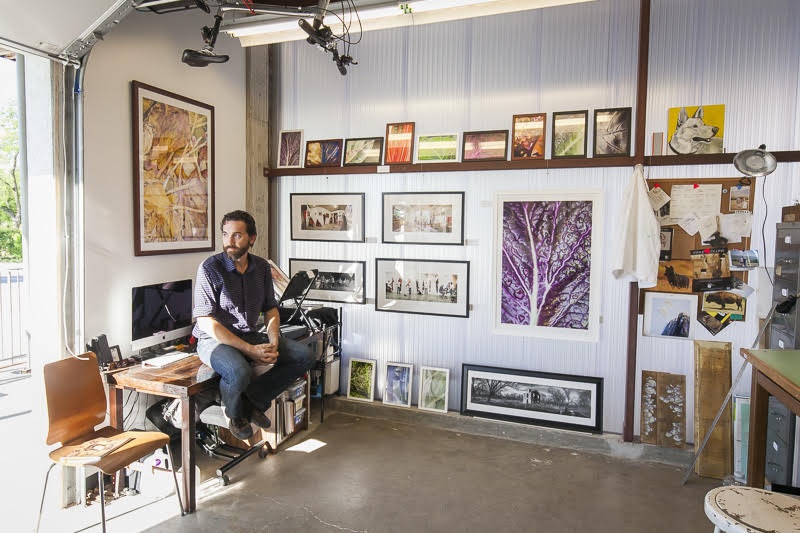 Scott in his studio at Canopy.
Where did you grow up?
I lived in Joliet, Illinois until I was 10, and then moved here with my parents.
What brought you to JBG?
I wanted to find some healthy food options after moving back from New York City in 2010, so I was looking specifically for a CSA. I found the JBG CSA and joined. When I was picking up one day at the Hope Farmers Market (the old location), I met Brent. I didn’t have anything going on at the time, and I thought I would just ask him if I could come out and take pictures of the farm. Then I did… that was on September 23, 2010 (almost 7 years ago exactly!). Carrie Kenney worked at the farm at that time as the office manager. She did the blog and everything. She asked me if I wanted to start taking pictures every week and get veggies as a trade. That’s how it all started.
What’s your favorite thing about photographing the farm?
One thing is once a week, I know that I’m going to be outside all morning. I usually get to watch the sun rise and enjoy the outdoors. I catch some fresh air, walk around, interact with people that work at the farm, and see what’s going on. It’s not always easy to make time for a hike, so I think it’s kept me sane over the years getting to go to the farm every week. I do a lot of walking out there, typically around 3-4 miles. It’s good exercise. Get my hands in the dirt, work on my Spanish, and learn about farming.
How did you get into photography?
I guess it’s just something that interested me as a teenager. Right around the time I graduated from high school, I started using my dad’s film camera, shooting slide film and it just seemed kind of magical to me. I started taking pictures more, and it just started to seem like something that I could do with my life. I really enjoyed it from the beginning.
Did you study photography?
I studied at Austin Community College, they have one of the best photography programs in the country. It has more of a commercial program as opposed to a more Fine Art based curriculum.
What is the best vantage point to shoot from for farm photography?
Up high. I try to stand on a truck, tractor, or trailer to get a higher vantage point, a wider view, or a different angle.
What are your five favorite photos and why do you love them?
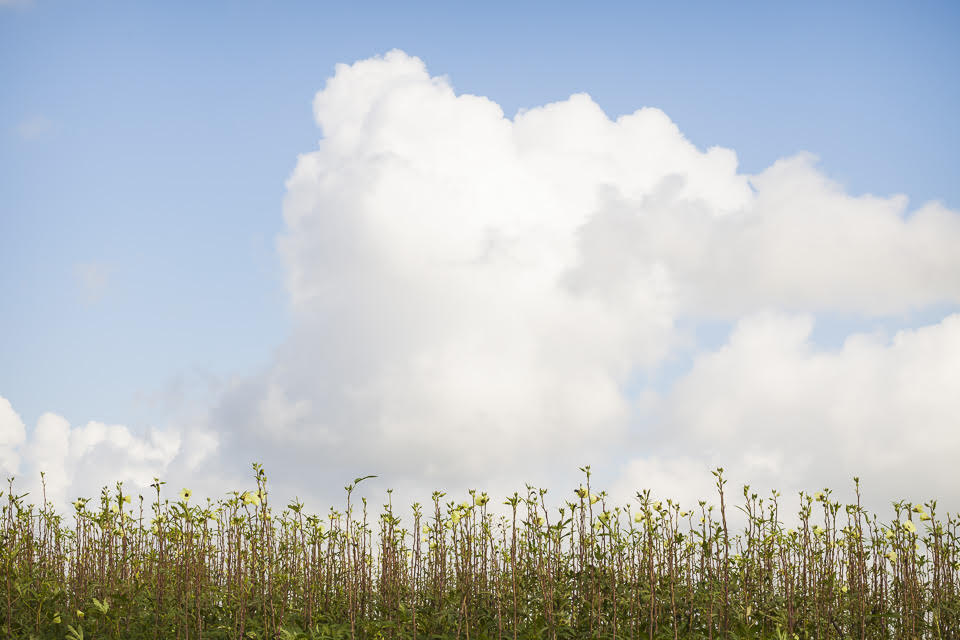
This picture of okra and sky was taken on my very first day on the farm. I like the simplicity and beauty of it and am often attracted to somewhat abstract or seemingly two dimensional scenes.
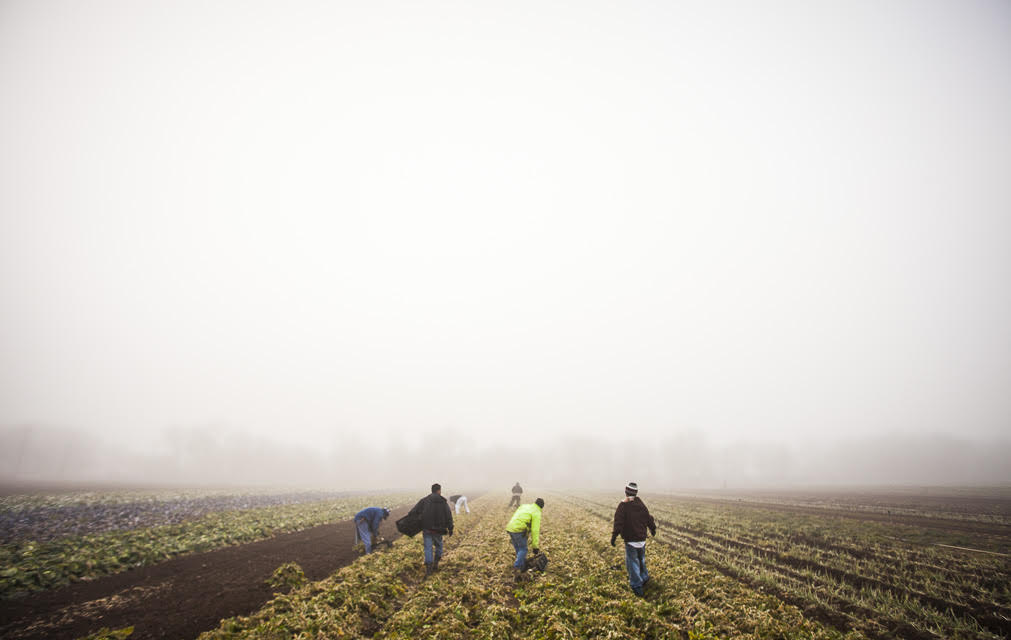
I’ve always loved the atmosphere of this image and the body language of the workers which almost suggest they are about to wander into the unknown.
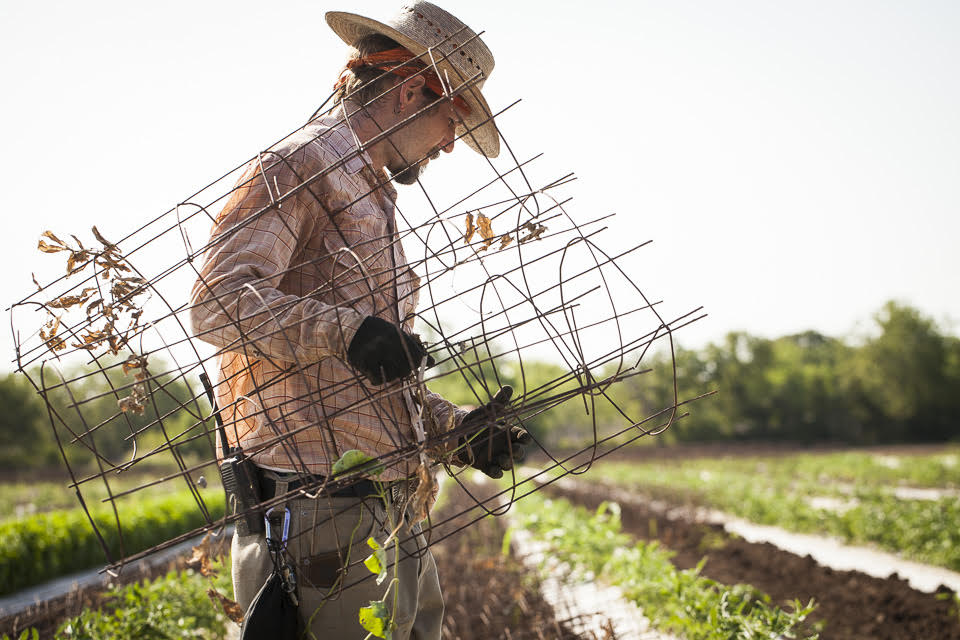
The composition of this image really appeals to me and I like how Christian is dressed and his movement.
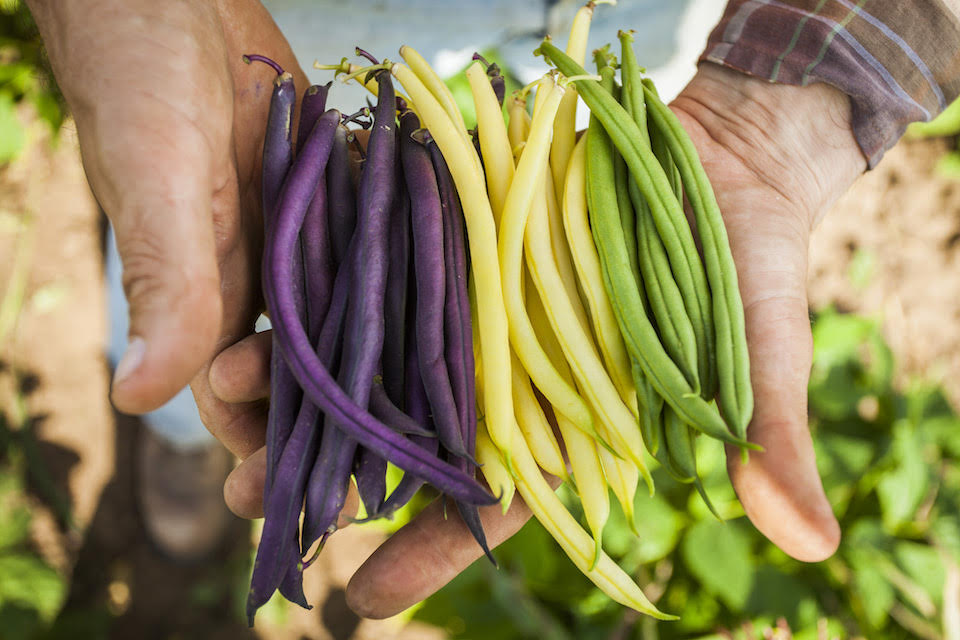
Color is also something I love. These are there different types of beans in the owner of the farm’s hands. The reward for all of the hard work, a beautiful harvest.
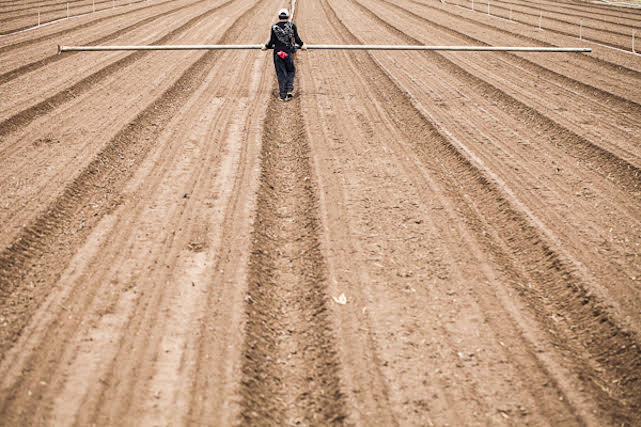
When I saw this guy laying down irrigation pipe he reminded me of someone walking on a tight rope with a balance pole. I like the lines and the balance of the whole scene.
What is the muddiest trip to the farm?
The muddiest? Well, there have definitely been times when my boot was sucked off my foot. They get so deep in the mud. I have also been out there when it’s pouring rain, luckily my camera is pretty weatherproof. I kind of like bad weather though, that’s when you can get some really cool photos and neat effects in lighting. There’s been days when my legs really get a workout walking miles through the mud for 4 or 5 hours.
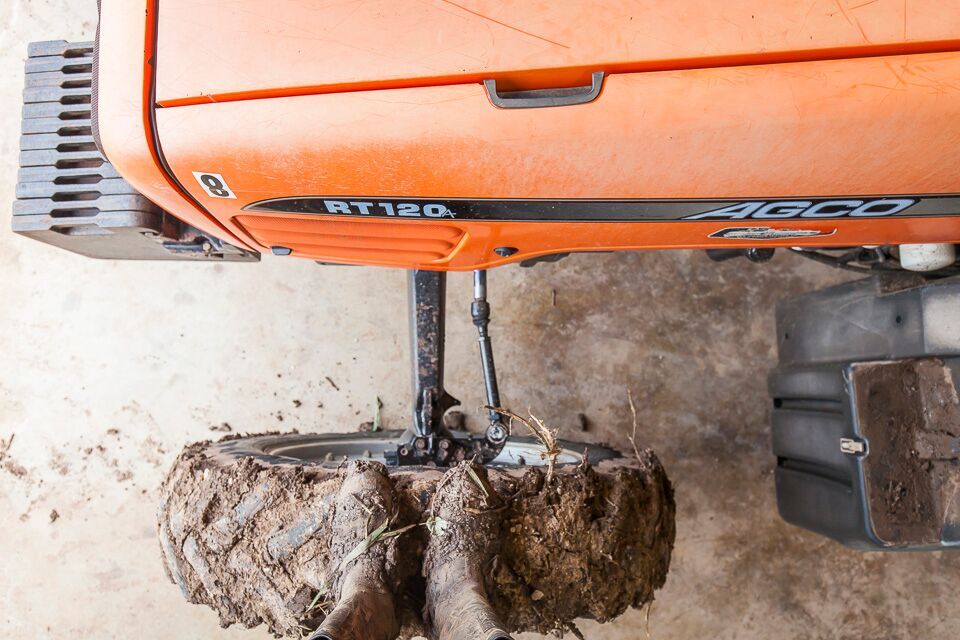 Muddy boots climbing on a tractor.
What’s the craziest thing that’s happened to you at the farm while shooting?
A couple months ago I was shooting in a field, and a coyote jumped out and ran away. I’ve also dropped a lens from the top of a tractor and it broke… I’ve fallen into mud and puddles quite a few times. Nothing too crazy, though.
Any pro tips on getting the best landscape/farm photos?
Get high, get low. If everyone is taking pictures from the same level, all the photos are going to look the same. If you want something different, either you get high or really low to the ground, and shoot up or a close up of something growing on the ground.
I have gotten into the habit of scanning the edge of the frame so that before I take a picture, I’ll follow the edge of the frame with my eye and look for anything that’s out of place or something that is jutting into the photo that might break up the composition. Then, I’ll just reframe it until all the edges seem clean to me. The way I shoot and have always shot is with a wide angle lens and a macro lens, so I’m getting two completely different perspectives. I can shoot a whole field or I can shoot a tiny bug on a plant with those two lenses. I always shoot raw so that I have the most latitude with adjusting photos and getting the most out of them.
If I’m photographing people, I always try to get them to smile because people can get pretty serious when they are concentrating on seeding or whatever they’re doing. The line that I always say to folks is, “pretend like you’re having a good time.” It always works. Everyone usually smiles and when people look they are having a good time, the pictures are usually much better.
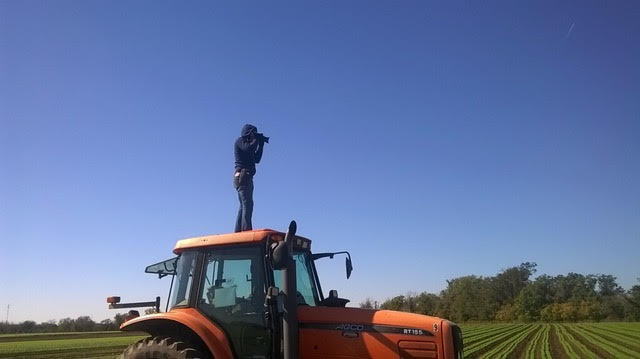 Scott getting the highest vantage point. Photo by Montana Stovall.
What are the tools that you use for your job?
Canon 5D Mark II, it’s 7 years old and very beat up. You can see how worn it is from hanging and rubbing against my clothes. This camera has been through a lot, it’s taken hundreds of thousands of photos. Also, I use a 16-35 mm wide angle lens and a 100 mm macro lens. When I’m editing, I use Lightroom to adjust and catalog the photographs. Editing is choosing the actual photos I want to use and adjusting is changing the actual photo. I use compact flash cards in my camera. I wear rubber boots because it’s muddy most of the time whether it’s raining or not (irrigation). I wear a hat and clothes that I don’t care about... I want to be able to lay down on the ground and not worry about getting dirty. I have a little pouch I attach to my belt that holds onto the lens that I’m not using. Finally, a knife in case I need to cut something.
What’s your life like outside of photographing the farm?
I work one other day a week for the farm. I do deliveries down to San Antonio. I started as a photographer, but soon after that JBG started doing home and CSA deliveries. I was essentially the first person to start doing home deliveries because I delivered for Whole Foods and Fedex for a while. I used to do that full time, but now it’s just part time. I like to try to travel, to see art, go to galleries/museums. I like reading and hanging out with my girlfriend. I’m a big collector - I collect art, books, and Native American stone artifacts like arrowheads.
I’m working on a couple projects currently that I’m going to unveil during EAST this year. I’m creating a website that will allow me to sell my photography online which will include farm images. All of the printing and framing would be done here locally. I’m also working on a podcast about art in Austin. I really want to learn how to become a better interviewer, and I feel like podcasts have always been really beneficial to me. I know a lot of artists and gallery owners, so I thought it would be really interesting to interview them about their art. Thus, I spend a lot of time working on building those up those projects.
I’m a perpetual class taker. I’ve recently taken a permaculture design course, before that I studied herbalism, while simultaneously taking an adult survival intensive course. The finale of the survival intensive was that we had to stay out in the wilderness for three days without anything. We had to build a shelter, and we killed a few snakes and ate them as that’s all we had besides berries to eat. That was really fun. Now, I’m in a Texas Master Naturalist class. So I’m training to be a naturalist. I’m learning about plants, mammals, birds, trees, and pretty much anything that you can think of. I’ve been volunteering for Lady Bird Johnson Wildflower Center, too. I’m always trying to learn new things, and I’m very interested in the natural world.
Do you cook a lot?
I don’t cook as much as I should. I cook around twice a week. I do get a lot of veggies, I share a lot of them with my friends. I feed a lot of people I know - whatever I don’t think that I’m going to use, I spread the wealth. I definitely think that cooking is a great skill, and I want to get better at it. My favorite thing to make is mac and cheese, but I beef it up with veggies. I usually cook some protein with some onions and garlic, saute some kale or whatever greens we have, and then mix them in with the pasta and cheese.
What would people be surprised to learn about you?
I think most people who don’t know me are surprised to learn that I’m a farm photographer to be honest. I don’t think that there are hardly any farms that have a staff photographer for one thing. So, when I tell people that’s what I do, they are usually a little perplexed or think that it’s interesting and different. There might be photographers where farm photography is part of what they do, but I don’t know of any other photographers that are on the staff of a farm full-time. I mean, I created this job, which is a cool way to do it. There was a need... the farm has always been media-minded, and has always had an online following. so it only made sense to enhance the visual side of that. I was in Santa Fe 3 or 4 years ago, and was talking to a guy about being a photographer at an Austin farm, and he immediately asked if it was JBG. He knew my work! There are people all over the country that know about JBG and know my photos.
What’s your favorite and least favorite thing to photograph on the farm?
My favorite thing thing to photograph is probably flowers. Anything really colorful really gets my attention. I like getting really close and capturing textures of leaves and dew drops. The closer, the better. If it’s an interesting color, shape, or texture, that’s the most interesting thing to me. I try to get at least 4 or 6 different situations or scenes to cover. This is so I feel like I’ve covered enough material every week. Different areas of the farm, different people doing different things - I like to have as much variety as possible. I like going to the farmers markets, too and seeing that side of JBG.
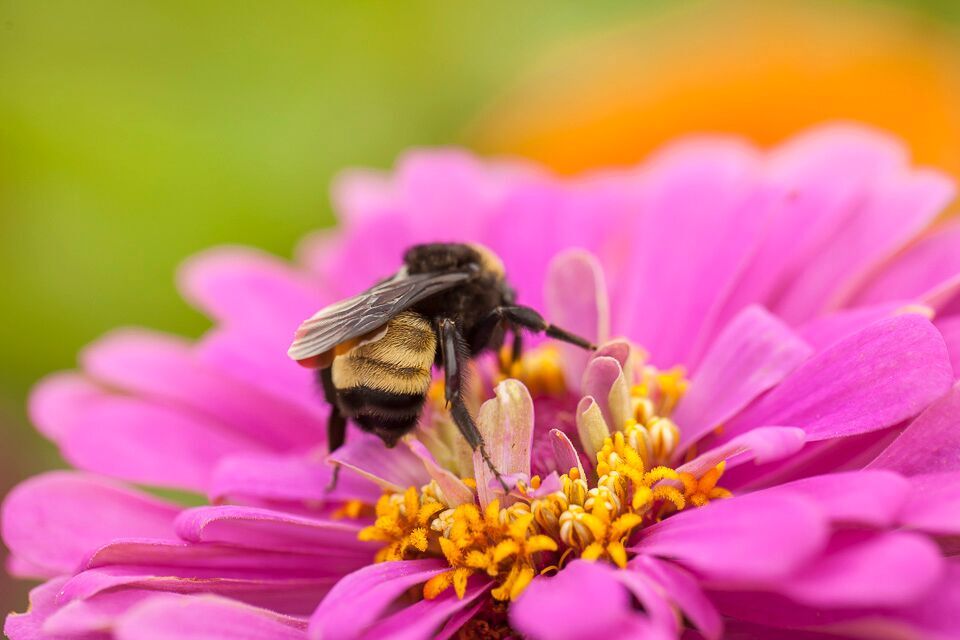 Close-up beauty.
My least favorite thing to do is to capture the same thing over and over again every week. There are certain seasons where week after week, people are doing the same thing for months. It gets a little monotonous. I mean, there are only so many images that you can take of picking eggplant or harvesting sweet potatoes. I like looking for diversity. Monotony is very challenging.
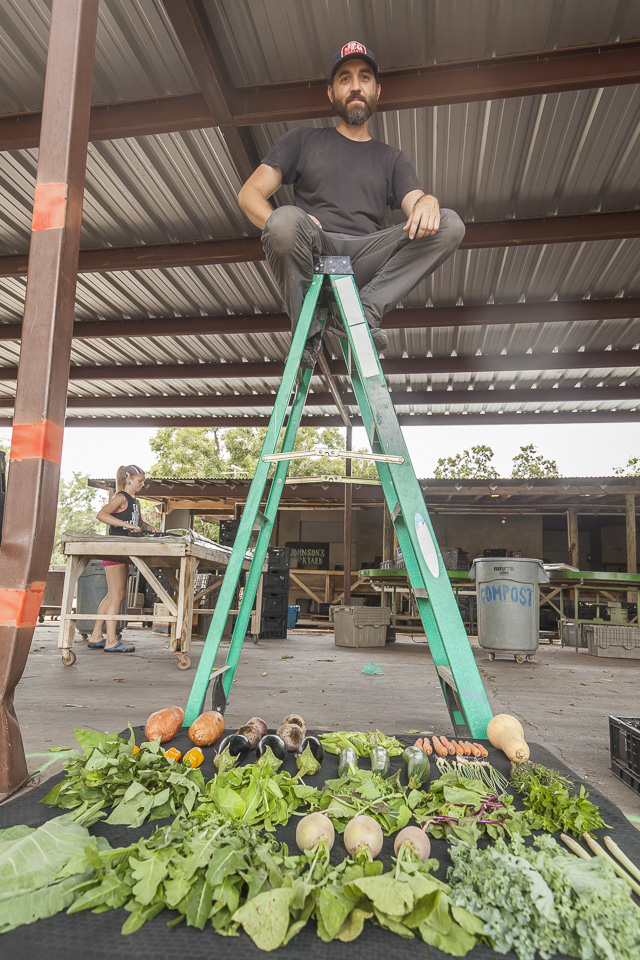 Scott getting the weekly CSA box shot from his favorite vantage point. Photo by Ada Lisa Broussard.
What is your favorite season?
Whenever it’s not too hot or not too cold. That could be any time of the year, really...
What have you learned from your role?
I’ve learned a lot about farming, for sure. I think I’ve refined my compositional eye quite a bit over the years. I’ve developed a more distinct style to my photography. It’s not often as a photographer that you get to participate in such a long term project where you are shooting the same thing every week for 7 years. It’s not the most common situation. Usually you are just shooting one-off things. It definitely has it’s challenges. Sometimes you are shooting the same thing over and over again and you have to find a way to make it look fresh or different. You have to try to come up with an image that no one’s ever seen of that subject. It pushes you as a photographer to get more creative. I’ve learned how to push through monotony and try to find ways to look at something differently and make it interesting. In general, I’ve become a better photographer, and become more comfortable with my equipment. Also, I’ve learn to better relate to people who work on the farm and met tons of people as well.
If you were stuck on an island, what three things would you bring?
- A good knife
- A container for water
- A good tent
Staff Survey: If Scott were a veggie, what would he be and why?
Ada: Potato. Like a potato, he's usually behind the scenes (underground), but is as integral to our operations as a potato is to the American diet. Plus, like a potato, he has a thing with digging in the dirt. His rootedness to the earth and to our farm is what brings us inspiring photos week after week. Who can deny a french fry? Who can deny the beauty of Scott's photos? See what I mean?Mike Mo: Watermelon radish - rugged masculinity on the outside, artful beauty within. Understated.
Heydon: Totally agree with Mike Mo on this one. Scott is just like a watermelon radish, for sure.
Krishna: Tomatillo, he's always behind the curtains.
A huge thank you to Scott David Gordon for his nonpareil work week after week, and for making time to talk with us! 'Til next time.
WEEK 38 IN PHOTOS
09/22/17 — Heydon Hatcher
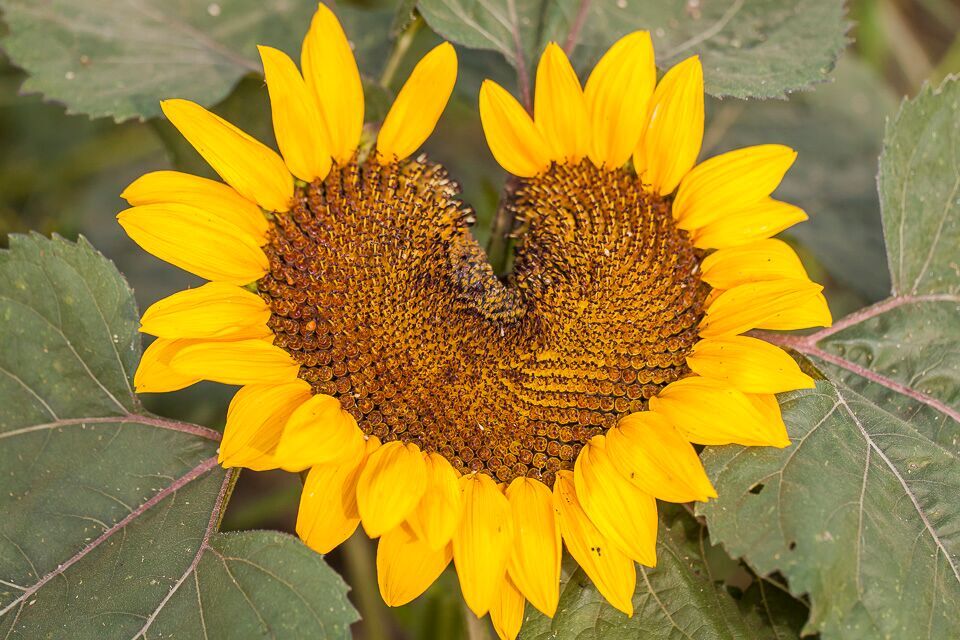 Sunflower showing some love. Photo by Scott David Gordon.
Updates from Becky Hume
We visited the Mueller's Farmers Market this past week to catch up with one of our most bustling markets. We are still in the midst of the busiest planting window for the Fall crops and catching up from Harvey. There has been a lot of machinery malfunctioning, so it's been a tricky week to coordinate!
Vicente is harvesting sweet potato as a rapid pace. We have a bumper crop this year, many are the size of footballs. Fa;; crops are just starting to be ready. It is very exciting to have radishes, kale, and soon broccoli!
 Radishes at the market. Photo by Scott David Gordon.
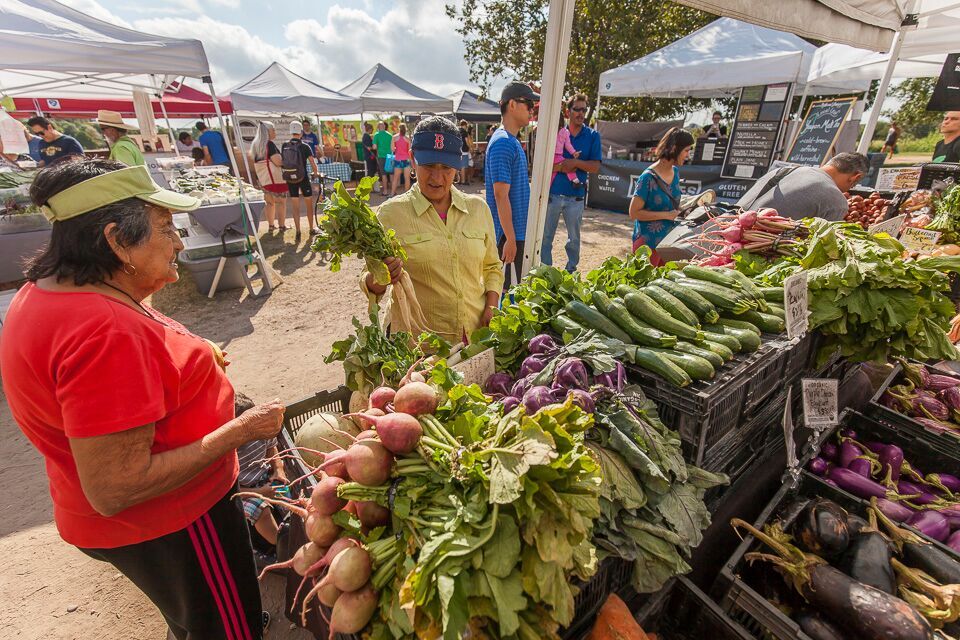 Mueller Farmers Market shoppers. Photo by Scott David Gordon.
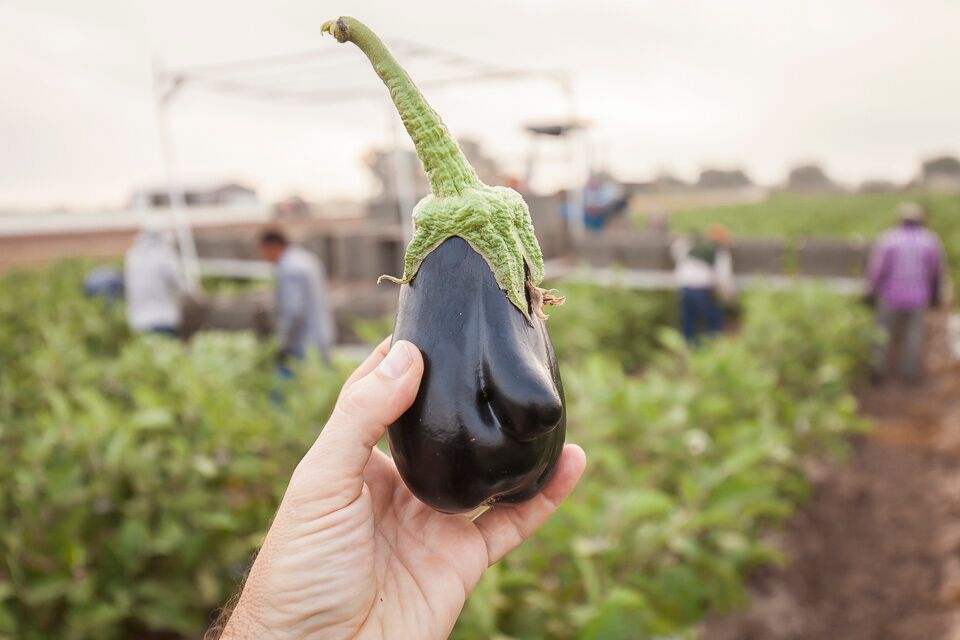 Eggplant oddities. Photo by Scott David Gordon.
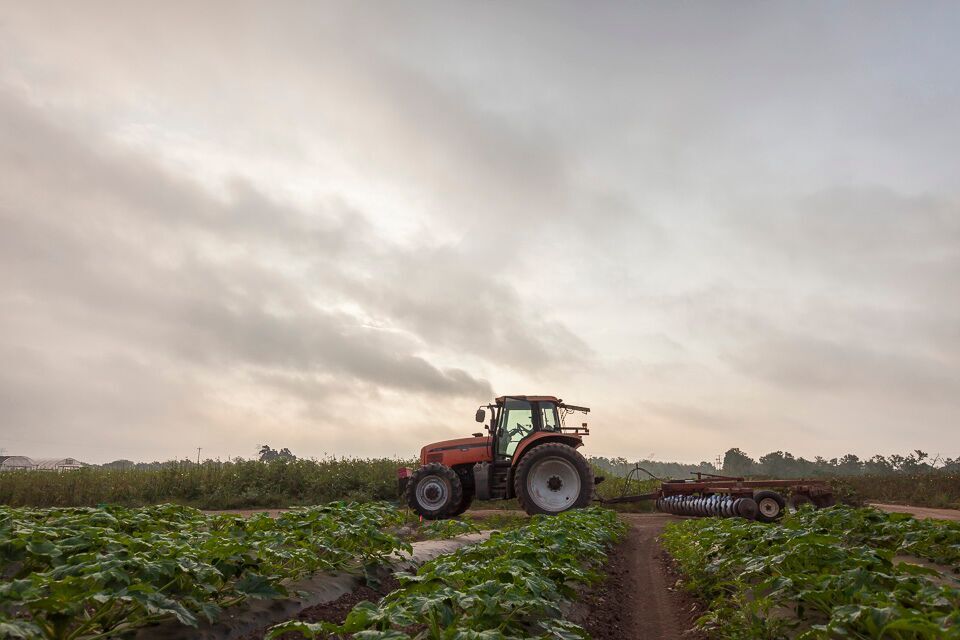 Early morning tractor work. Photo by Scott David Gordon.
 Baby squash. Photo by Scott David Gordon.
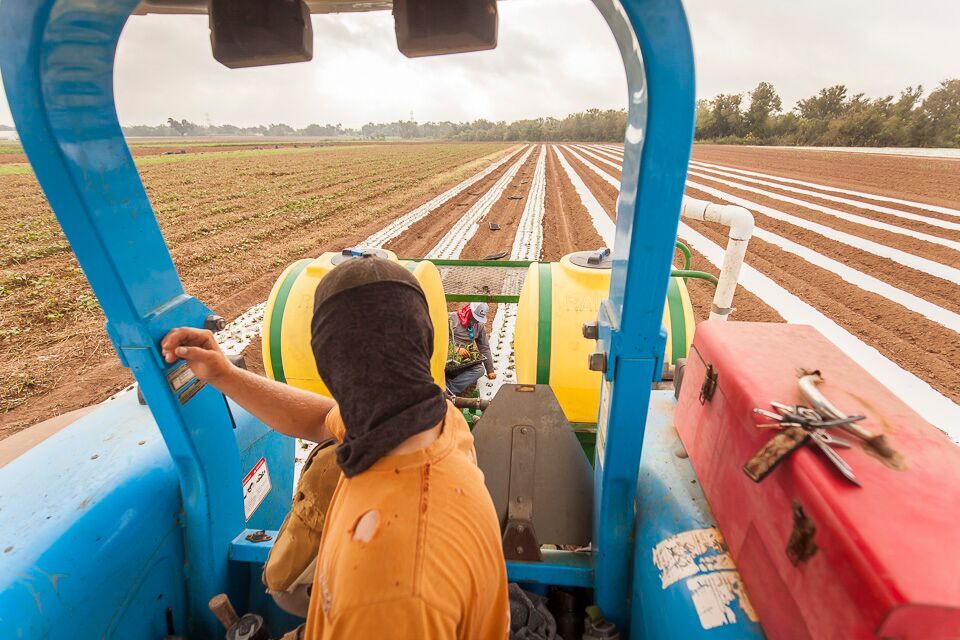 Checking the scene on the transplanter. Photo by Scott David Gordon.
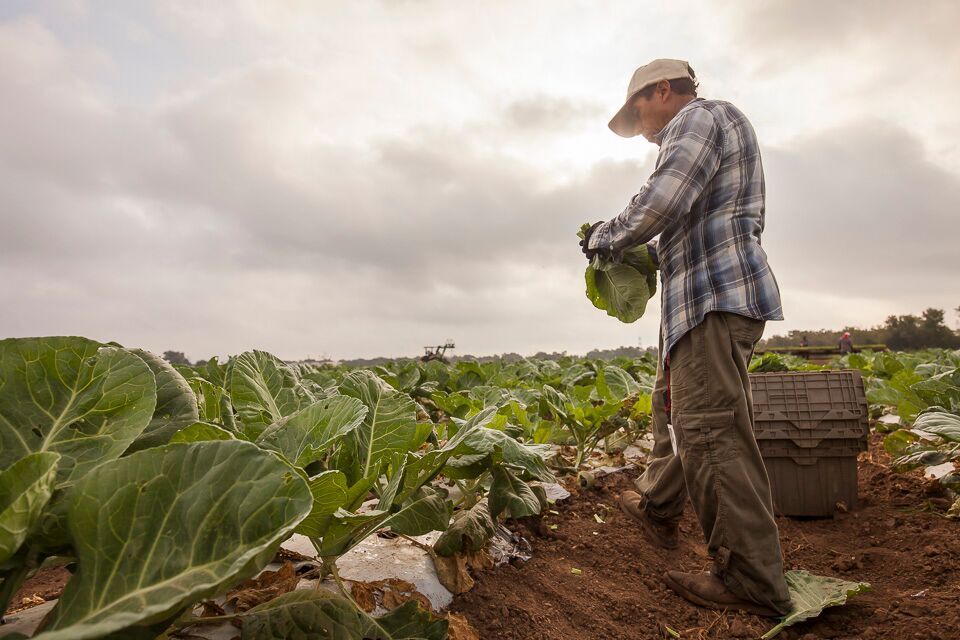 Collard harvest. Photo by Scott David Gordon.
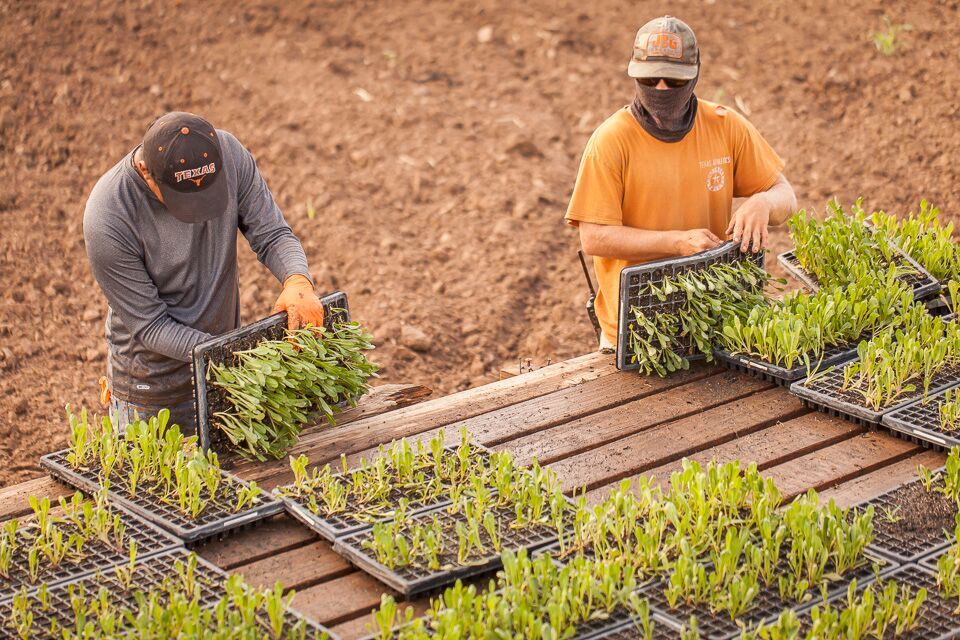 Preparing the transplants. Photo by Scott David Gordon.
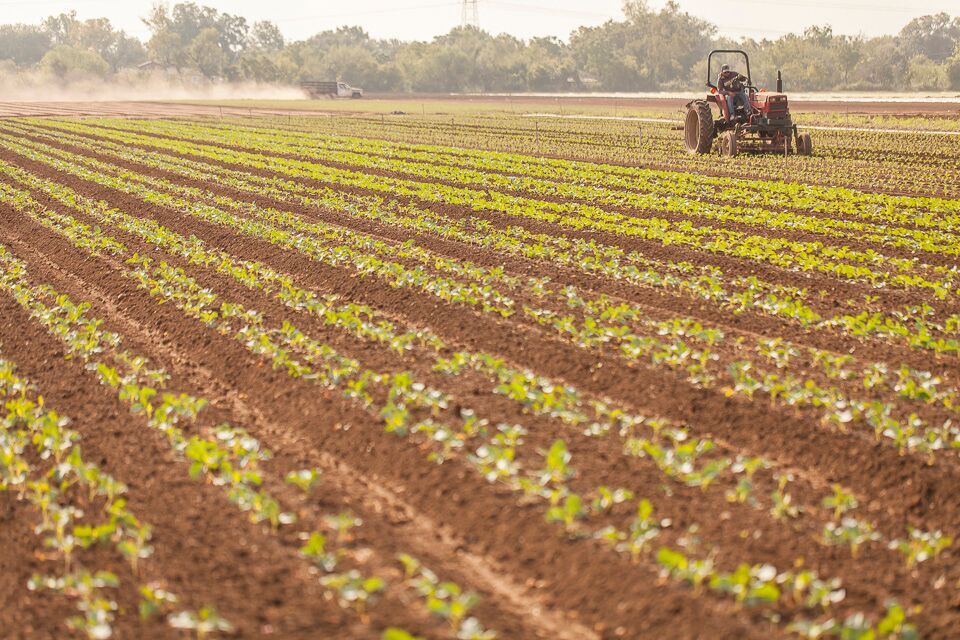 Growing! Photo by Scott David Gordon.
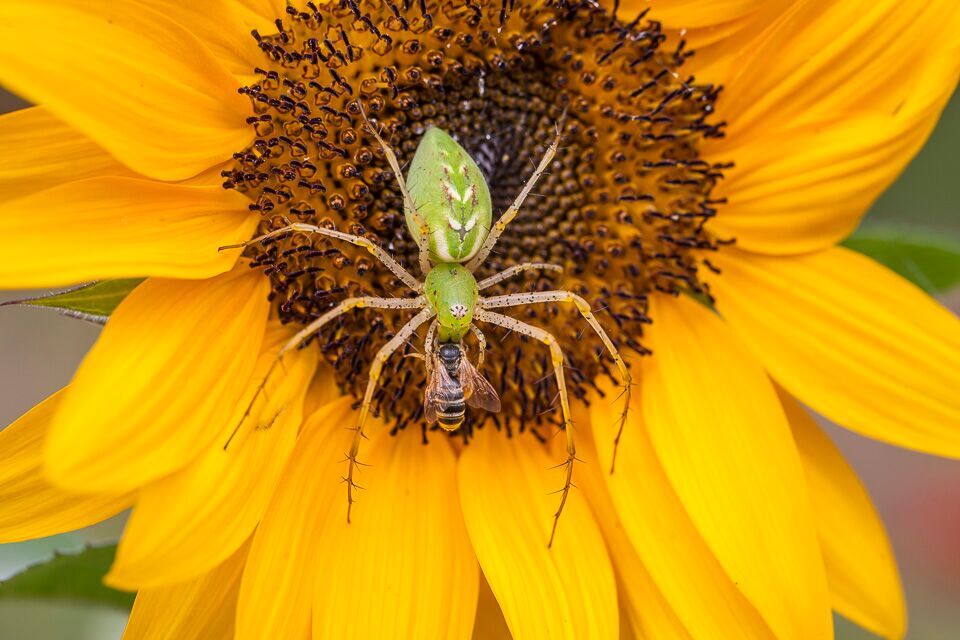 Lunch. Photo by Scott David Gordon.
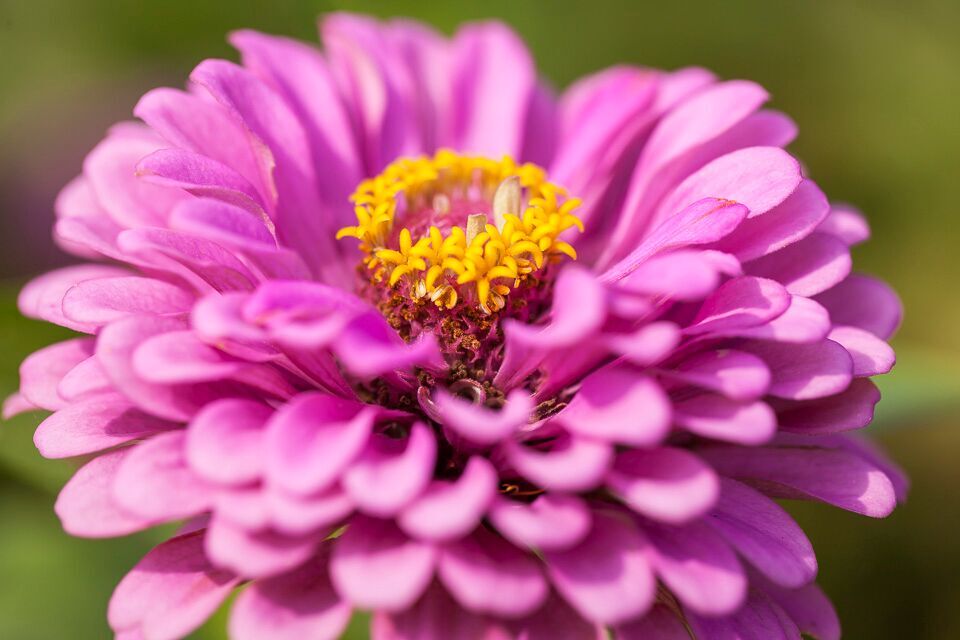 Zinnia beauties. Photo by Scott David Gordon.
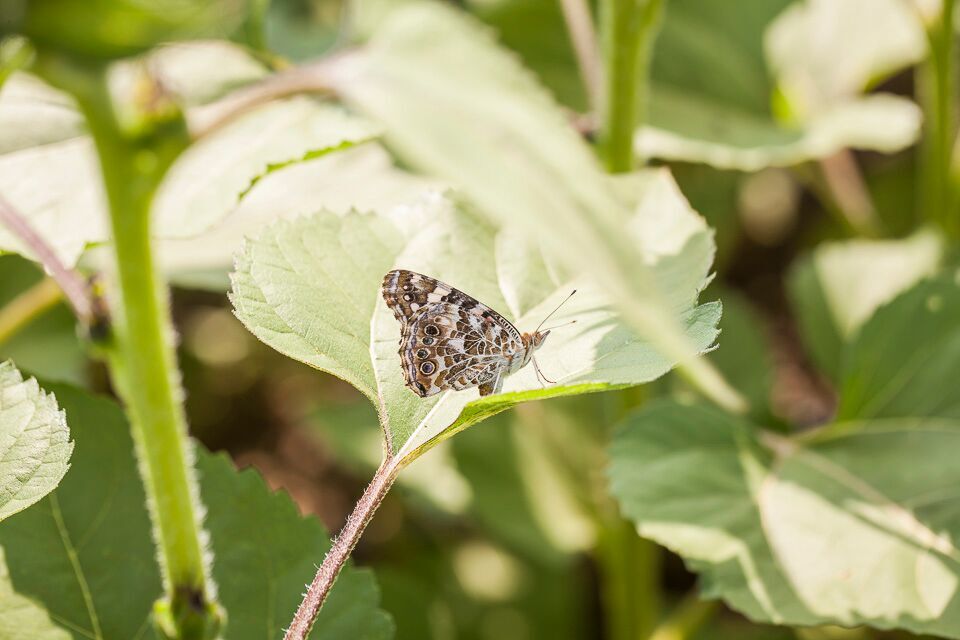 Landing. Photo by Scott David Gordon.
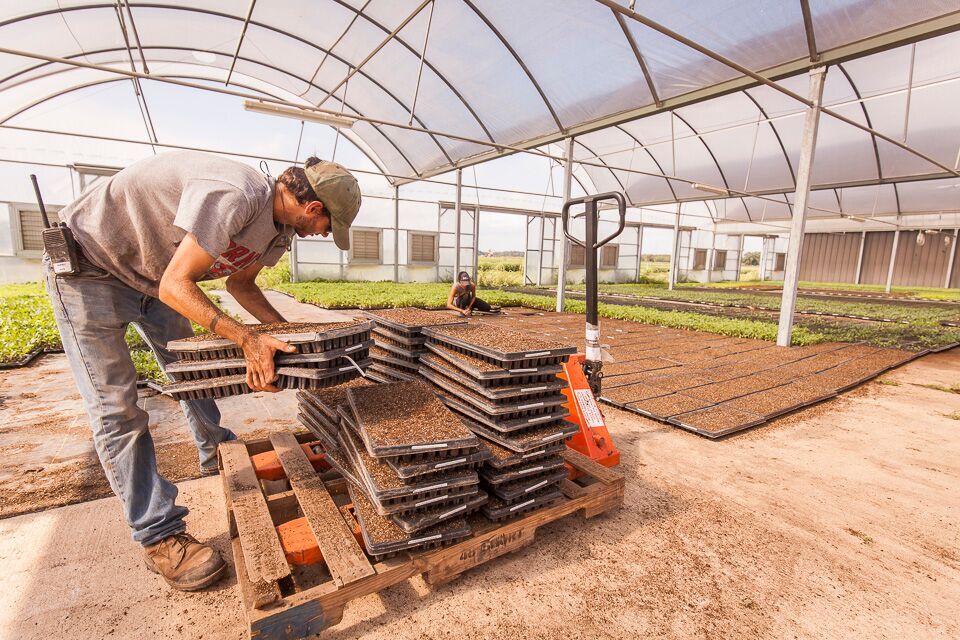 Kirby getting the seedings into the greenhouse to germinate. Photo by Scott David Gordon.
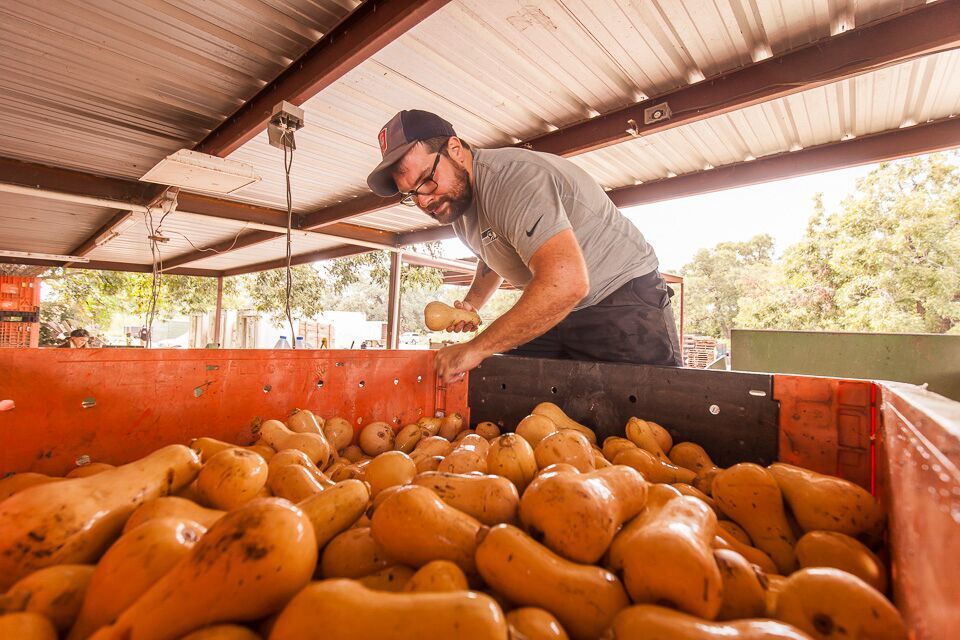 Ryan sifting through the motherload of butternut squash. Photo by Scott David Gordon.
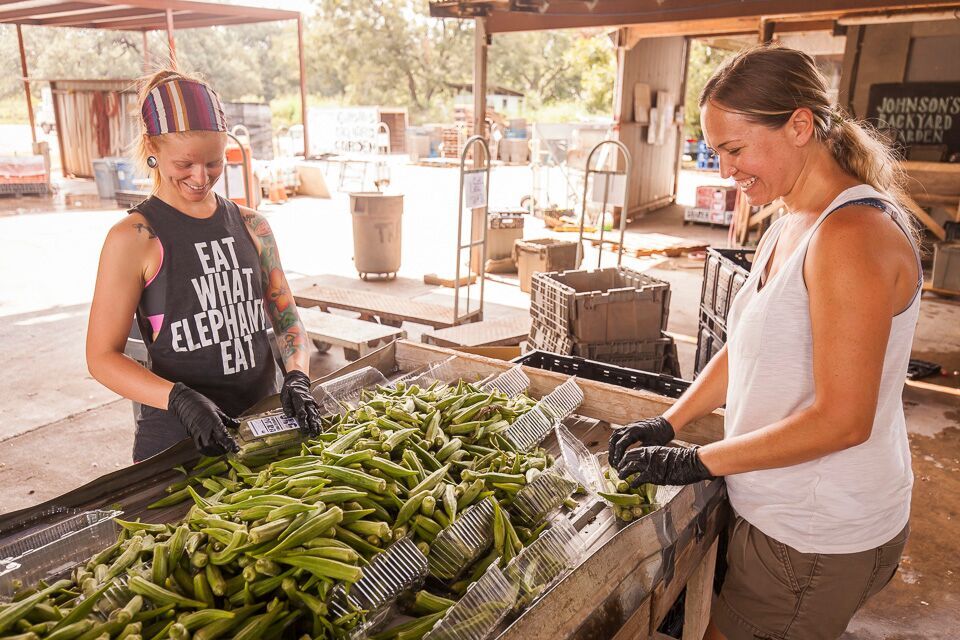 Sorting sisters! Photo by Scott David Gordon.
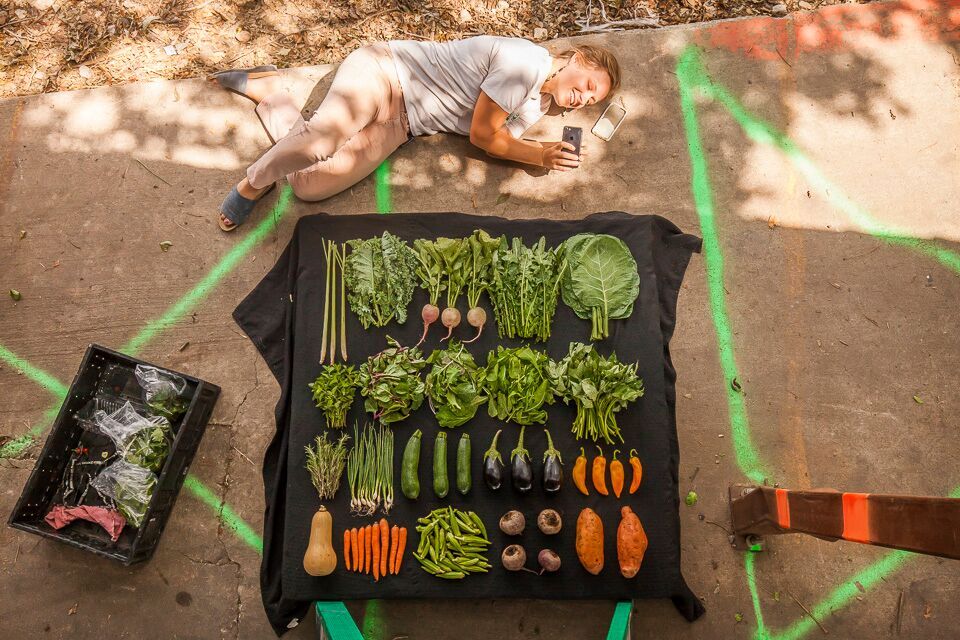 Ada getting a shot of Scott for this week's post. Photo by Scott David Gordon.
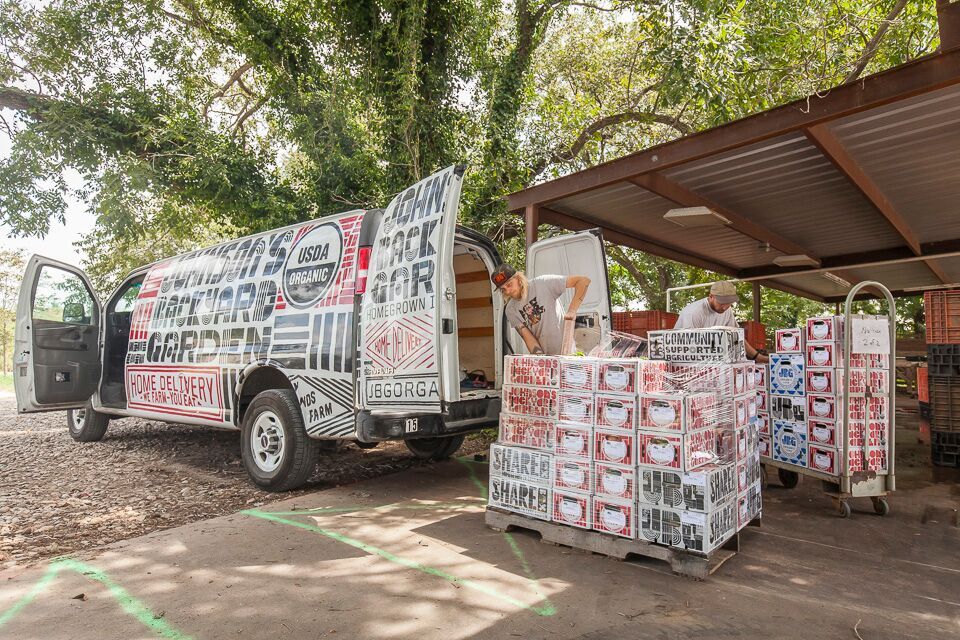 Boxes going out. Photo by Scott David Gordon.
SUMMER DUMPLINGS
09/21/17 — Heydon Hatcher
Recipe and Photo by Mackenzie Smith
Last week’s CSA came with okra and Summer squash, two ingredients I know I’ll be missing in a couple of months when root vegetables and bitter greens take up the lion’s share of our weekly box. Keeping dumpling wrappers on hand make for an inexpensive way to fold the best of the season into a pocket that can be fried up and served with a tasty dipping sauce or frozen for later.
This recipe is nod to one of my favorite Summer dishes: okra cooked in bacon fat and stewed in tomatoes. For the dumpling filling, I stirred sliced, drained squash into the hot okra mixture, and added sharp cheddar cheese before folding the mixture into dumplings at freezing for later.
I get my wrappers from Hana World Market over on Parmer Ln -- and highly recommend a shopping trip to that wonderful store -- but you can find basic wonton wrappers at HEB, and those work just as well in a pinch.
![]() Photo by Mackenzie Smith
Photo by Mackenzie Smith
Remove dumpling wrappers from the freezer and thaw in the refrigerator for at least 4 hours.
Place sliced squash in a colander and sprinkle with salt, then leave it to and drain while you prepare the rest of the dish.
Cook the bacon in a hot skillet and set aside once it reaches desired crispiness. Try not to eat all of it while you make the okra. Add shallot or onion to the hot fat and cook on low-medium heat until translucent. Add okra to the pan and turn up the heat to medium-high. Cook for about 20 minutes, stirring often. Spoon in apple cider vinegar, then add the tomatoes to the pan. Turn up the heat and cook until most of the liquid is reduced. Remove from heat and stir in the squash, then add salt and pepper to taste.
Crumble what is left of the bacon and stir it into the dish. Mix in shredded cheese before you start to fold the dumplings.
Place folded dumplings onto a sheet pan lined with parchment paper. If you plan on freezing your dumplings, place the sheet pan in the freezer for about 20 minutes before putting them in ziplock bags back in the freezer.
If you are cooking the dumplings now, I suggest pan frying them like Diana Kuan suggests, over at Appetite for China.
Last week’s CSA came with okra and Summer squash, two ingredients I know I’ll be missing in a couple of months when root vegetables and bitter greens take up the lion’s share of our weekly box. Keeping dumpling wrappers on hand make for an inexpensive way to fold the best of the season into a pocket that can be fried up and served with a tasty dipping sauce or frozen for later.
This recipe is nod to one of my favorite Summer dishes: okra cooked in bacon fat and stewed in tomatoes. For the dumpling filling, I stirred sliced, drained squash into the hot okra mixture, and added sharp cheddar cheese before folding the mixture into dumplings at freezing for later.
I get my wrappers from Hana World Market over on Parmer Ln -- and highly recommend a shopping trip to that wonderful store -- but you can find basic wonton wrappers at HEB, and those work just as well in a pinch.
- 4-5 small yellow squash or zucchini, sliced into ¼ inch thick half moons
- 2 slices of bacon
- 1 shallot or red onion, chopped
- 1 lb of okra, cut into ½ inch slices
- 1 tablespoon apple cider vinegar
- 2 cups canned tomatoes
- 1 tablespoon salt
- ¾ cup cheddar cheese
- Dumpling wrappers
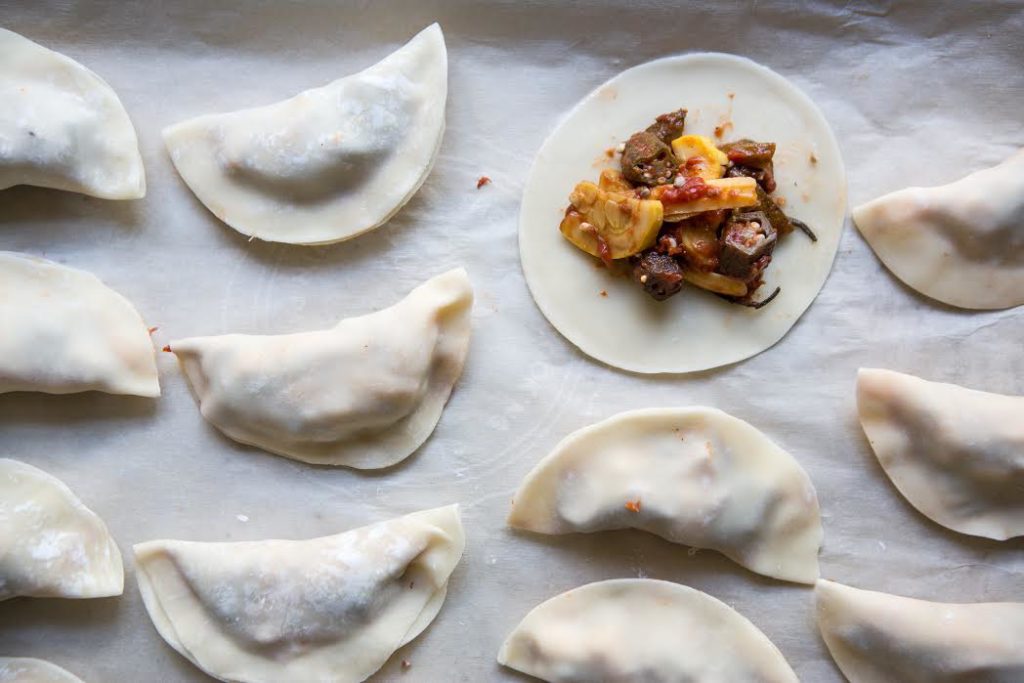 Photo by Mackenzie Smith
Remove dumpling wrappers from the freezer and thaw in the refrigerator for at least 4 hours.
Place sliced squash in a colander and sprinkle with salt, then leave it to and drain while you prepare the rest of the dish.
Cook the bacon in a hot skillet and set aside once it reaches desired crispiness. Try not to eat all of it while you make the okra. Add shallot or onion to the hot fat and cook on low-medium heat until translucent. Add okra to the pan and turn up the heat to medium-high. Cook for about 20 minutes, stirring often. Spoon in apple cider vinegar, then add the tomatoes to the pan. Turn up the heat and cook until most of the liquid is reduced. Remove from heat and stir in the squash, then add salt and pepper to taste.
Crumble what is left of the bacon and stir it into the dish. Mix in shredded cheese before you start to fold the dumplings.
Place folded dumplings onto a sheet pan lined with parchment paper. If you plan on freezing your dumplings, place the sheet pan in the freezer for about 20 minutes before putting them in ziplock bags back in the freezer.
If you are cooking the dumplings now, I suggest pan frying them like Diana Kuan suggests, over at Appetite for China.
CSA BOX CONTENTS WEEK OF SEPT 18TH
09/19/17 — Scott
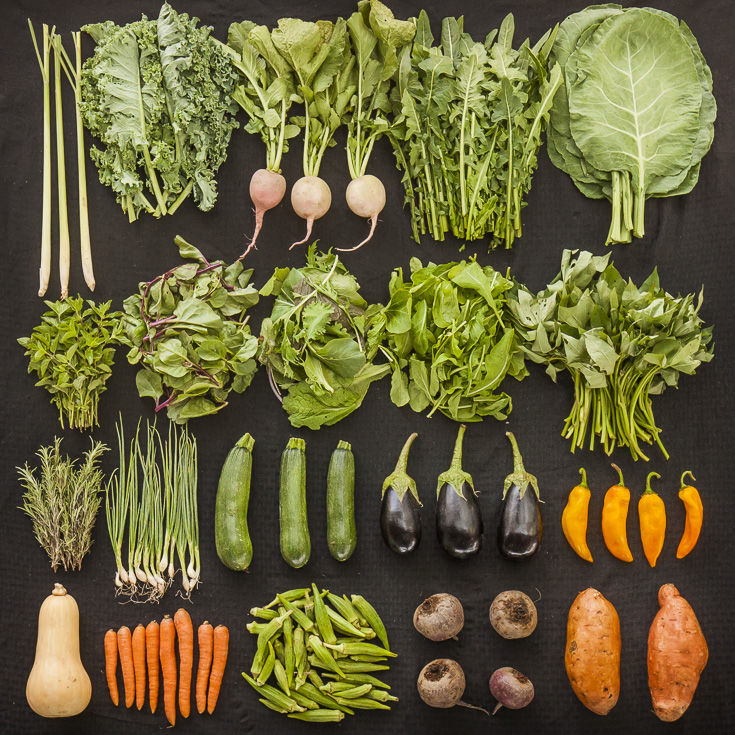 CSA Box Contents Week of Sept 18th
Large Box
Beet, Red
Bok Choy
Carrot, Orange
Eggplant, Medley
Greens, Arugula
Greens, Kale, Curly
Herb, Spearmint
Kohlrabi, Purple
Onion, Multiplying
Pepper, Jalapeno
Pepper, Sweet Medley
Potato, Sweet
Radish, Daikon Bunched
Beet, Red
Bok Choy
Carrot, Orange
Eggplant, Medley
Greens, Arugula
Greens, Kale, Curly
Herb, Spearmint
Kohlrabi, Purple
Onion, Multiplying
Pepper, Jalapeno
Pepper, Sweet Medley
Potato, Sweet
Radish, Daikon Bunched
Medium Box
Beet, Red
Bok Choy
Herb, Lemongrass
Herb, Spearmint
Okra
Pepper, Jalapeno
Potato, Sweet
Radish, Daikon Bunched
Squash, Butternut
Squash, Farmer's Choice
Beet, Red
Bok Choy
Herb, Lemongrass
Herb, Spearmint
Okra
Pepper, Jalapeno
Potato, Sweet
Radish, Daikon Bunched
Squash, Butternut
Squash, Farmer's Choice
Small Box
Eggplant, Medley
Greens, Collards
Greens, Dandelion
Herb, Lemongrass
Pepper, Sweet Medley
Potato, Sweet
Radish, Purple Daikon
Turnip, Scarlett
Eggplant, Medley
Greens, Collards
Greens, Dandelion
Herb, Lemongrass
Pepper, Sweet Medley
Potato, Sweet
Radish, Purple Daikon
Turnip, Scarlett
Individual Box
Carrot, Orange
Greens, Kale, Curly
Herb, Spearmint
Onion, Multiplying
Radish, Watermelon
Squash, Butternut
Carrot, Orange
Greens, Kale, Curly
Herb, Spearmint
Onion, Multiplying
Radish, Watermelon
Squash, Butternut
BROCCOLI: FROM SEED TO MARKET
09/15/17 — Heydon Hatcher
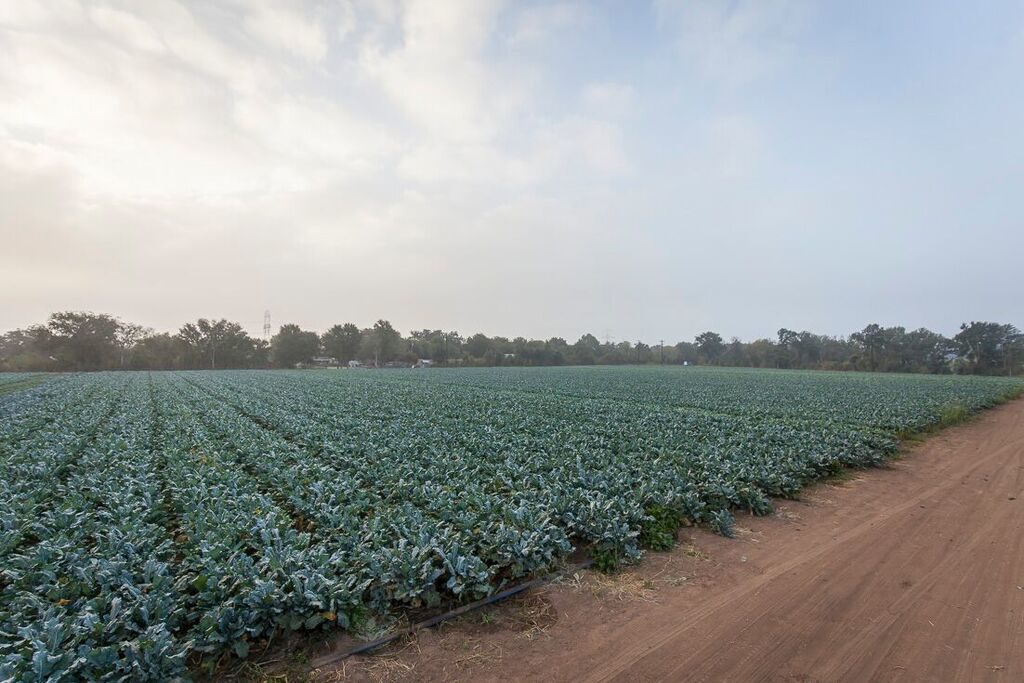 Broccoli field. Photo by Scott David Gordon.
As we ease into the Fall season, this week we are taking a journey with the Brassica family darling, broccoli. We are going to travel from seed all the way to the market stand with this cool weather-loving crop. There is a meticulous and carefully choreographed convergence of two farm systems that makes the magic of broccoli happen out at the farm. The tillage team works out in the field readying the beds as the greenhouse team grows the broccoli transplants, and they come together at exactly the right spot at the right time. There is little room for mistakes, and our expert team has the crop coordination down to an art.
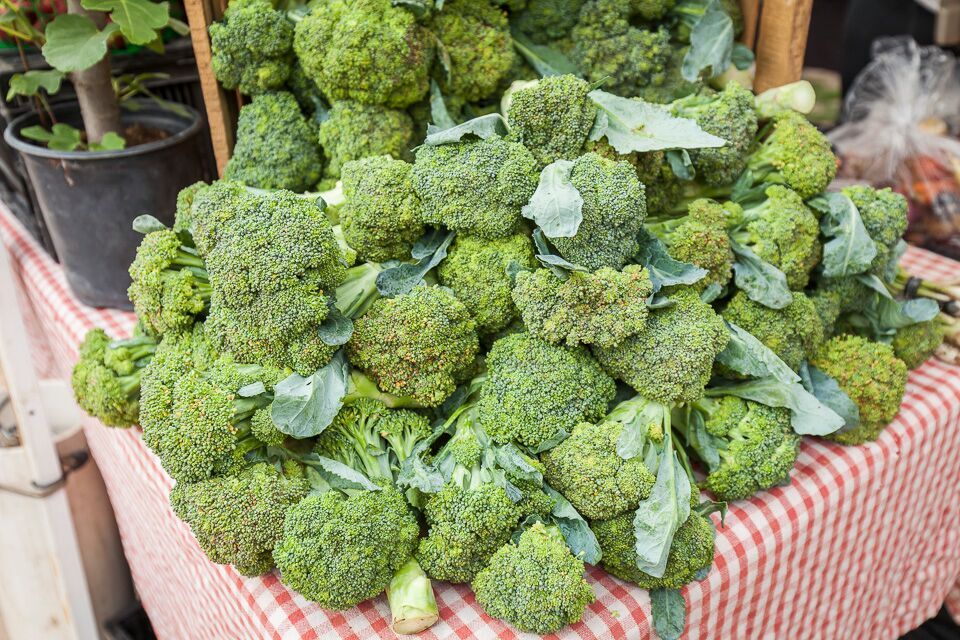 Market broccoli. Photo by Scott David Gordon.
SEEDING
Becky, our farm manager does the crop planning. Based on demand she uses average yield and weather information to plan how many beds of a crop like, broccoli, need to be planted each week. Once the weekly planting plan is set, she works with Kirby, our greenhouse manager to schedule seeding the transplants the correct number of weeks in advance. Broccoli takes 4 weeks from seed to be ready to plant-- but depending on weather it can vary. Based on the seeding plan, Kirby figures out the seeding schedule, along with how many trays and soil material he will need.For the batches of soil, we order in pallets of peat moss, vermiculite, and compost (which we already have on site)... then we mix them! We fill the trays with that soil, a process which the volunteers help with immensely as the greenhouse is a volunteer-powered operation most of the time.
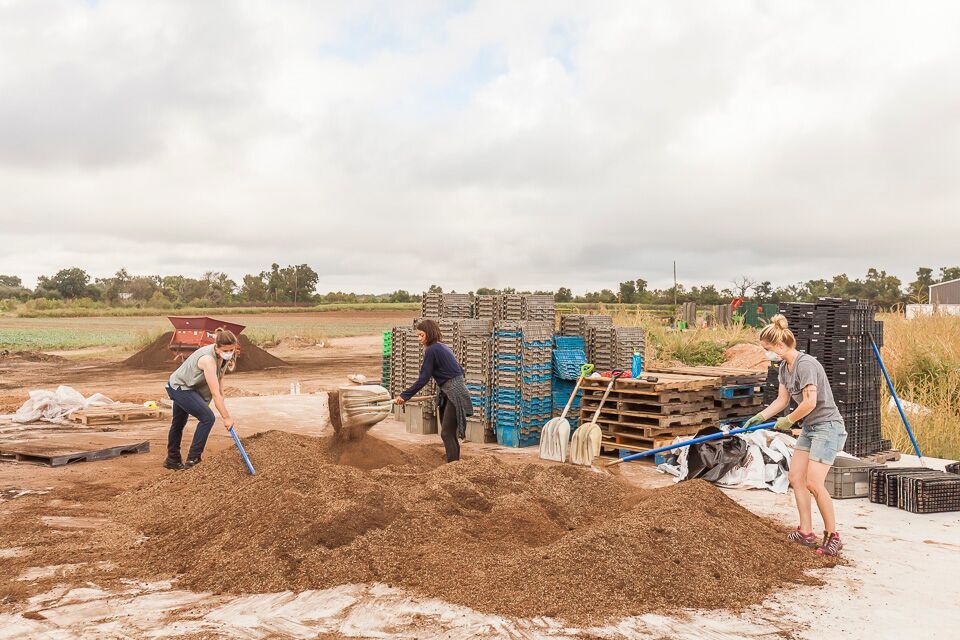 Mixing soil. Photo by Scott David Gordon.
Then we seed. Some crops you have to hand seed (put seeds in every cell by hand), but for broccoli seeds, the process works very well in the vacuum-seeder. This contraption is a plate with 128 holes which matches up to the 128 cells on a tray. They hook a vacuum up to said plate, it creates suction… we pour the seeds onto the plate and roll them around, so every little suction hole gets a seed on it. Once every hole has a seed in it, then the plate gets flipped over, we turn off the vacuum, and every seed finds a spot perfectly in each cell of the tray. Magic! We can seed almost 100 trays in an hour compared to the 8 to 10 trays per hour that get done via hand-seeding.
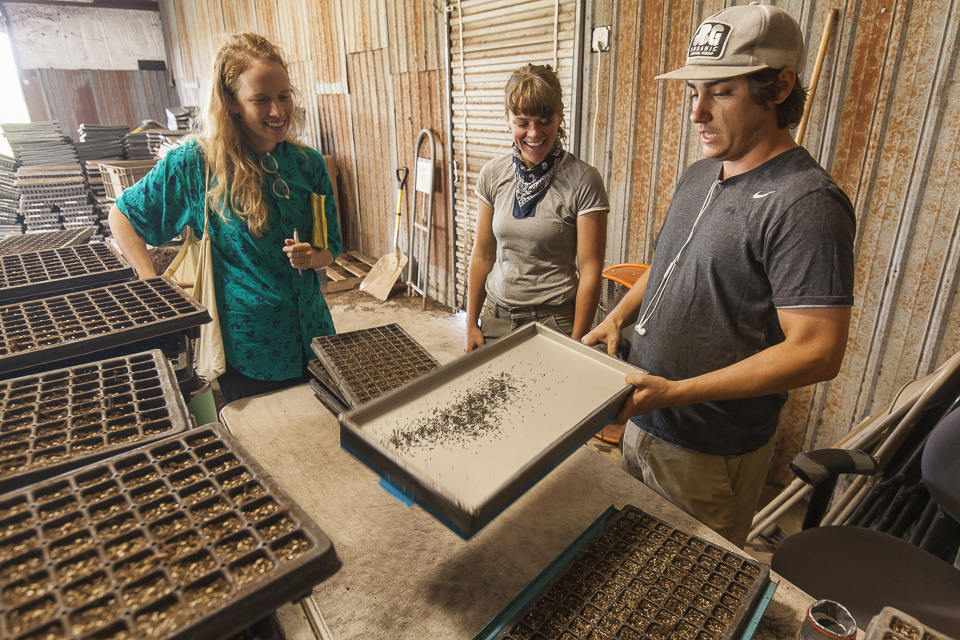 Julian showing off the magic of the vacuum seeder. Photo by Scott David Gordon.
We then top the trays with topsoil, and put them out in the greenhouse to germinate in blocks. This is where our greenhouse manager, Kirby, has to do a lot of monitoring and watering of these crop babies, until they are ready to be loaded onto the trailer and transplanted into the beds.
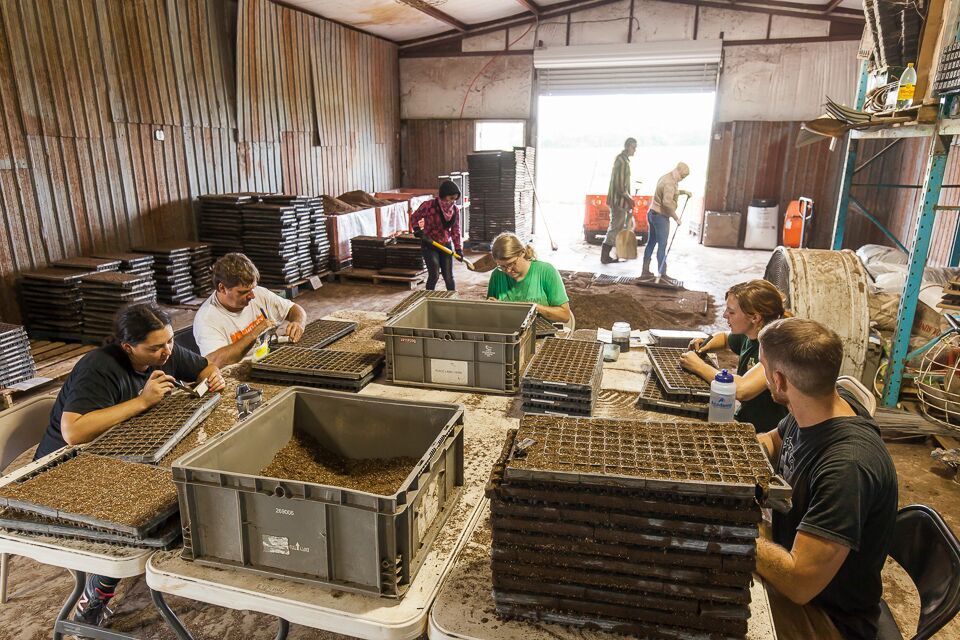 Direct hand seeding. Photo by Scott David Gordon.
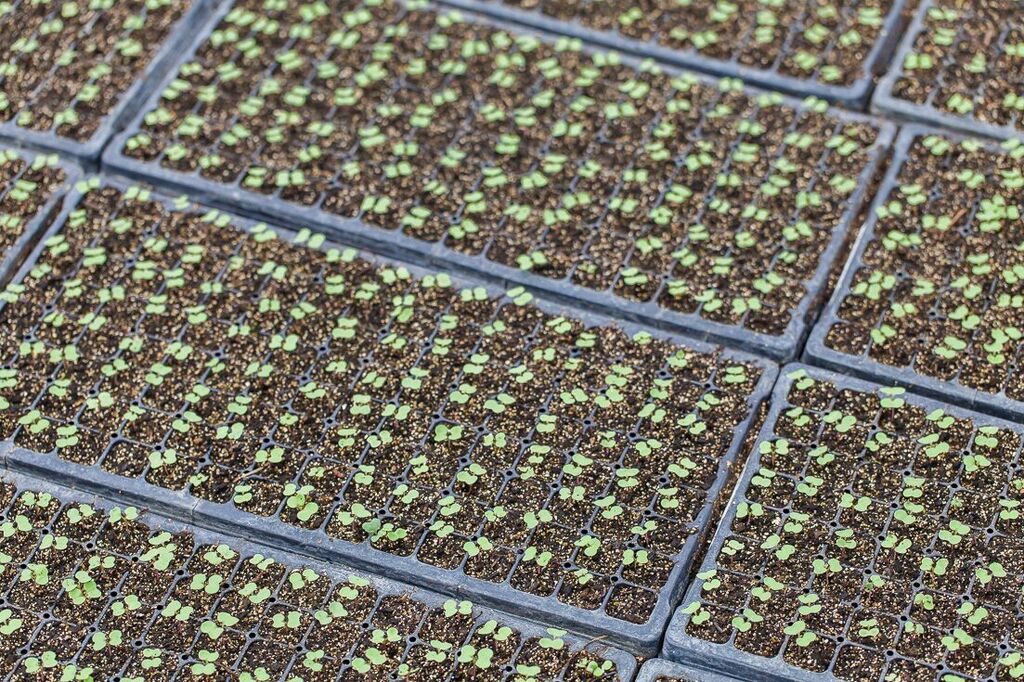 Broccoli growing in the greenhouse. Photo by Scott David Gordon.
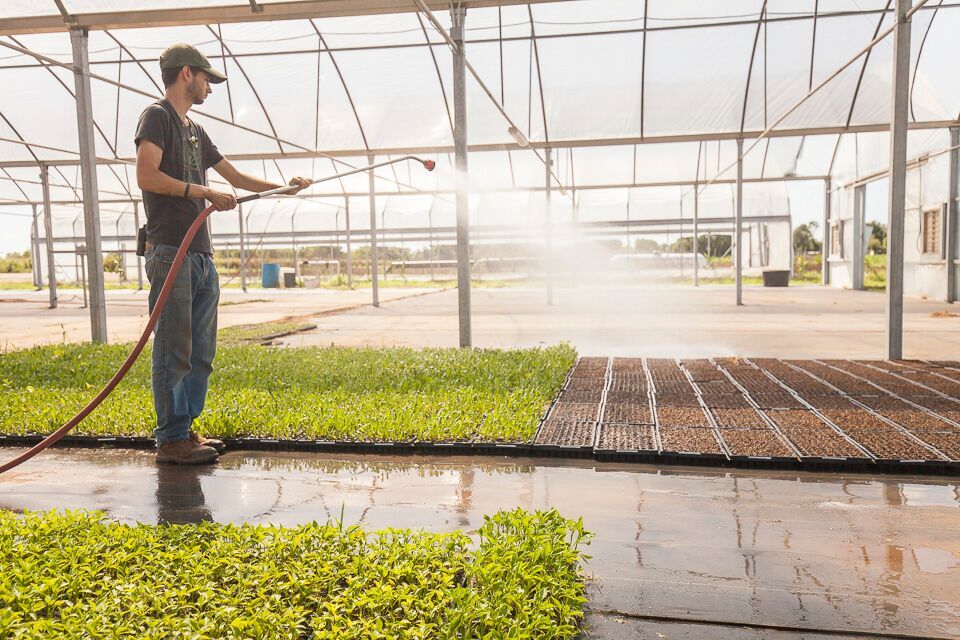 Kirby watering in the greenhouse. Photo by Scott David Gordon.
BED-MAKING
When we start the bed-making process, we usually rip a block of soil depending on what the block was used for previously. This process gets down really deep, creates better drainage, and makes space for new roots to set. After this, we usually disk the field. This slices up the soil, breaks up clods, chops up plant matter and residue so that it can be more easily incorporated into the soil.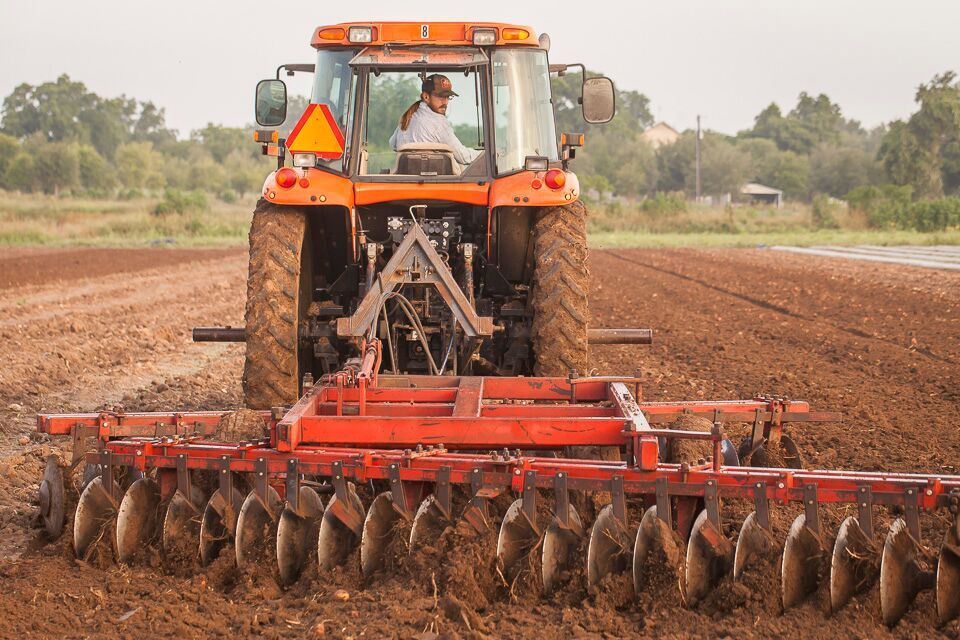 Montana on the disker. Photo by Scott David Gordon.
Next we use the listers, which start shaping the beds. It pulls soil from the furrows and dumps it into the center of the row. We have single listers and triple listers on the farm (fun fact: Brenton painted a picture of a lister for the Prizer Gallery Farmer as Artist show!). This implement scoops soil and keeps it in the center -- so we have the beginnings of a raised bed, albeit a very, very rough one. After we list the beds, we usually add fertility. We use the compost spreader for this which looks like a big red bucket wagon. It spreads the compost at an even rate across all the fields so it’s all very equally distributed.
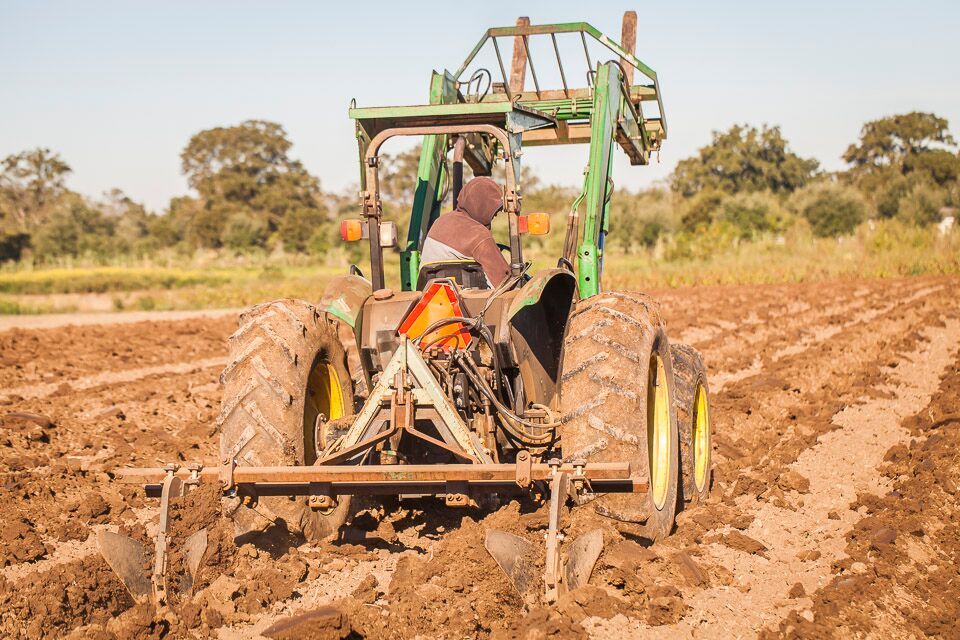 Lister. Photo by Scott David Gordon.
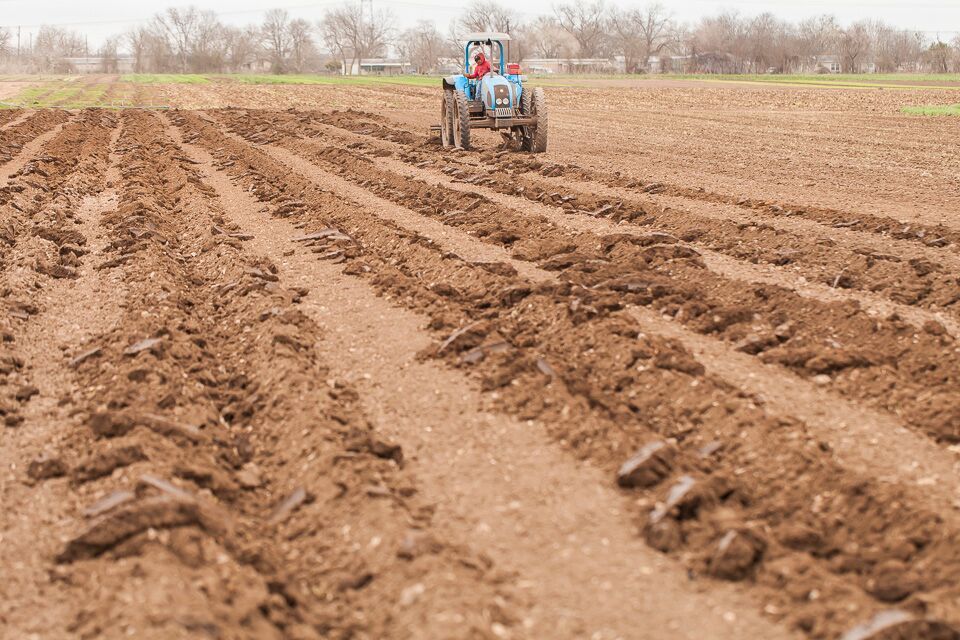 Listed. Photo by Scott David Gordon.
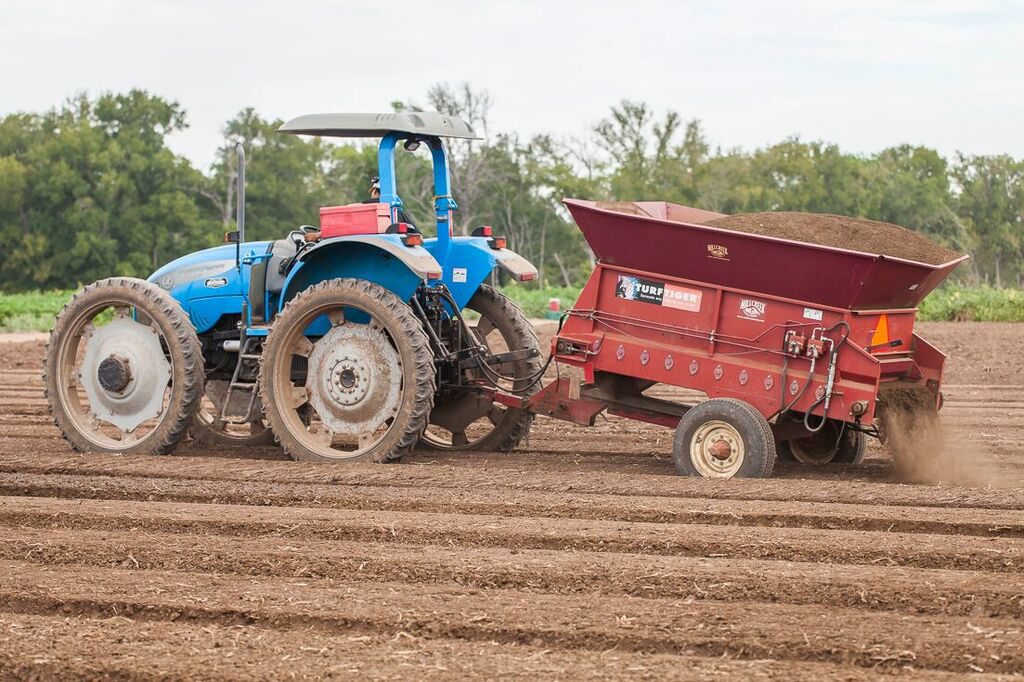 Compost spreader. Photo by Scott David Gordon.
Then comes the tilling. The tiller has tines (just like a regular garden tiller) which help incorporate the fertility.
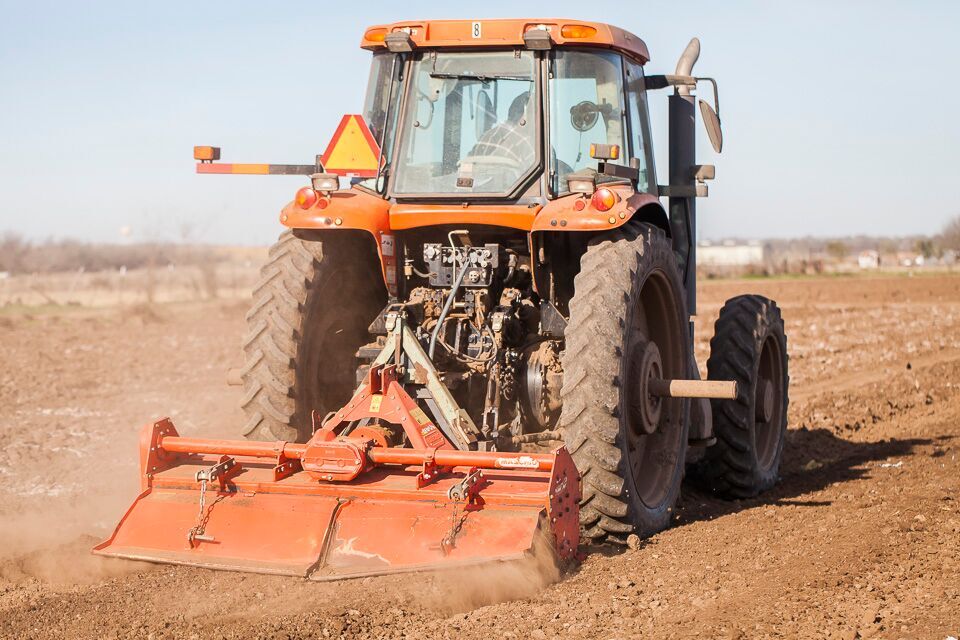 Tiller. Photo by Scott David Gordon.
The last step is the bed-shaper which goes over the top of the bed and has a very fine-tooth. It creates perfectly smooth, perfectly shaped beds. It is the finishing touch before we go through and lay drip tape.
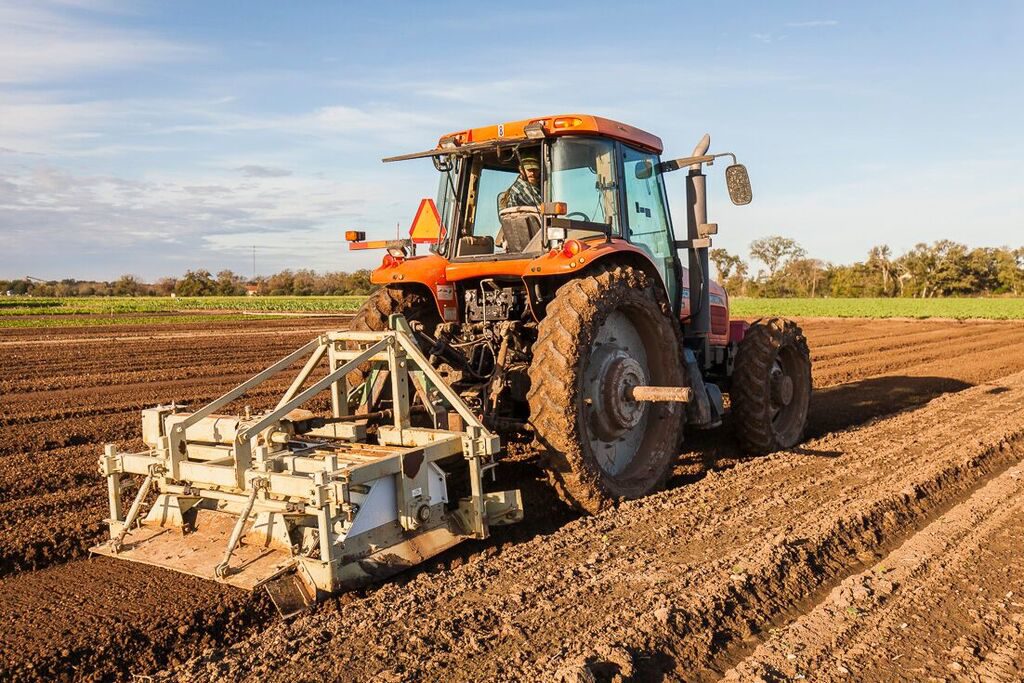 Bed-shaper. Photo by Scott David Gordon.
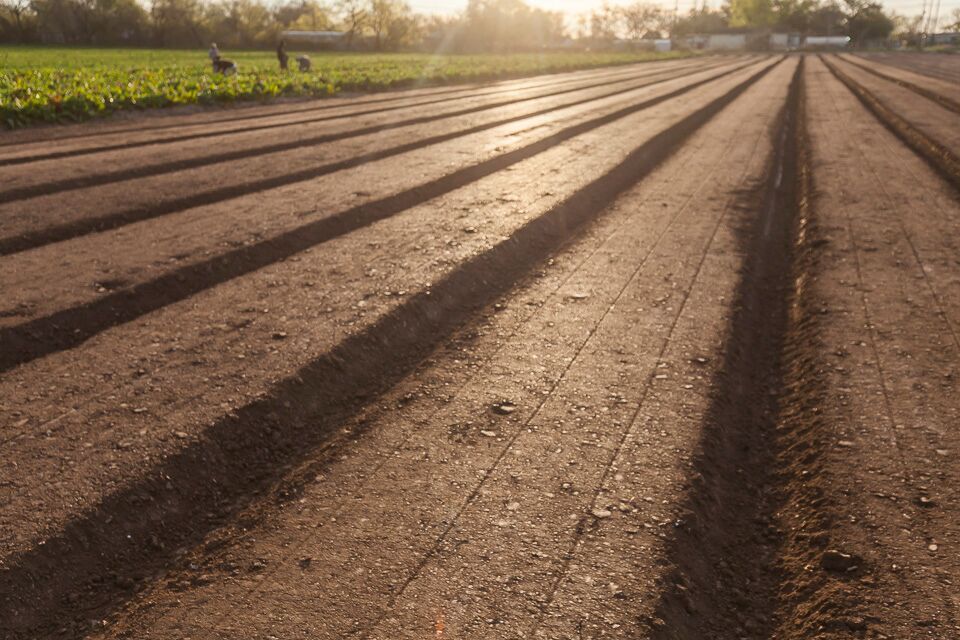 Smooth bed. Photo by Scott David Gordon.
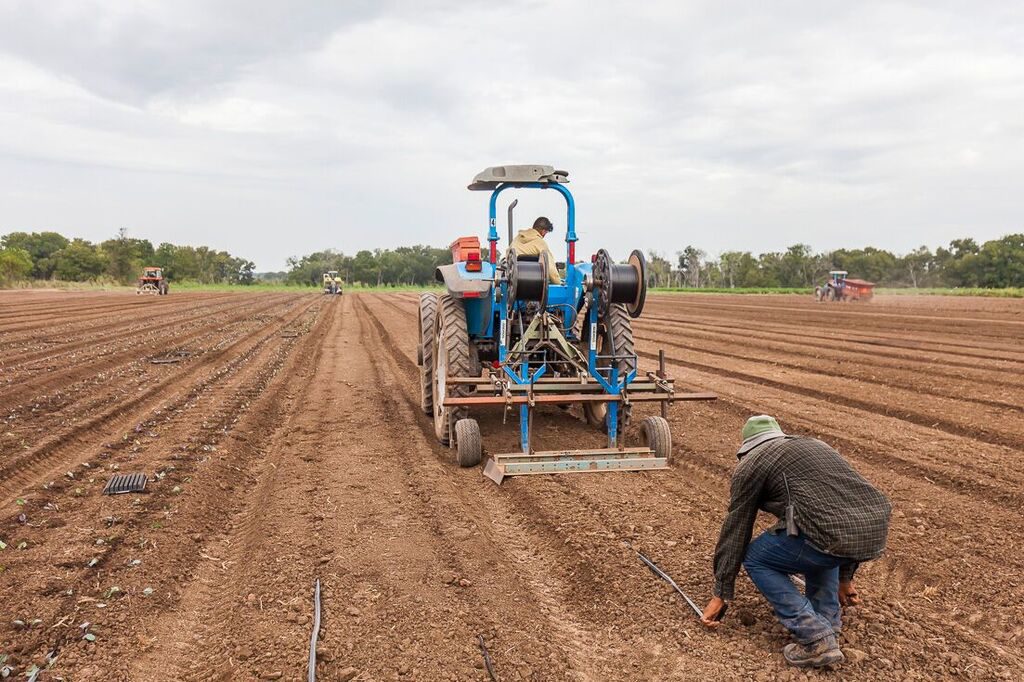
Then Temo comes in with the drip-tape shanker. The drip tape lines are secured right underneath the soil. This is so it doesn’t blow around in the wind, and it also helps the water move osmotically through the soil. This is so that we get a more moist and even watering. Finally, we come through with the transplanter. We plug in all the plants on either side of the drip tape. Yeehaw!
 Drip tape shanker. Photo by Scott David Gordon.
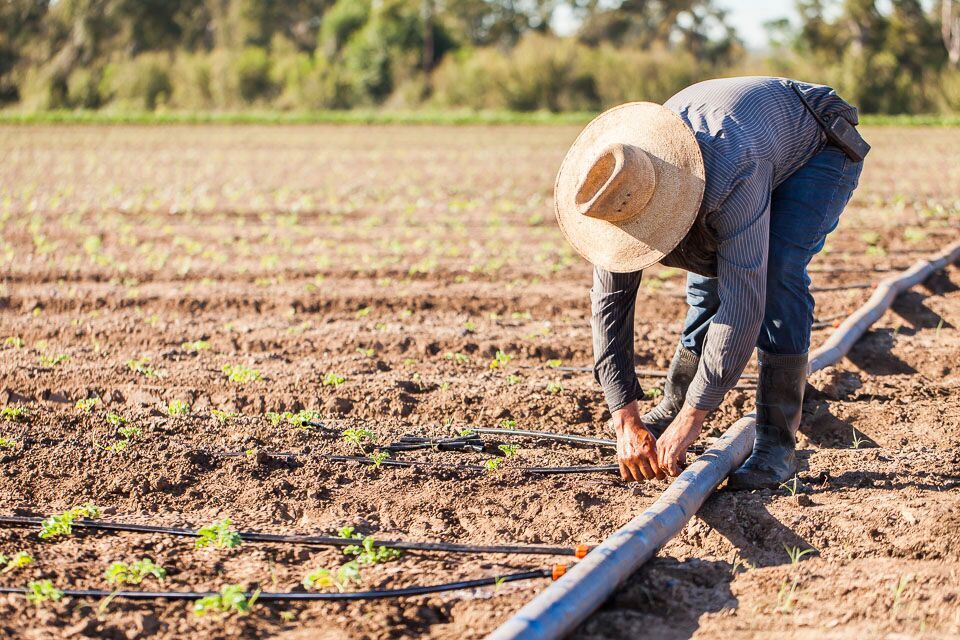 Making sure the drip tape is secure. Photo by Scott David Gordon.
Transplanting, Harvesting, Storage, and Market
Once the broccoli is ready in the greenhouse, we bring them out on trailers, and load up the transplanter. Two folks sit on this machine and plug in the plants by hand whilst someone quickly hands them the transplants as they move down the fields. Loading up the transplanter. Photo by Scott David Gordon.
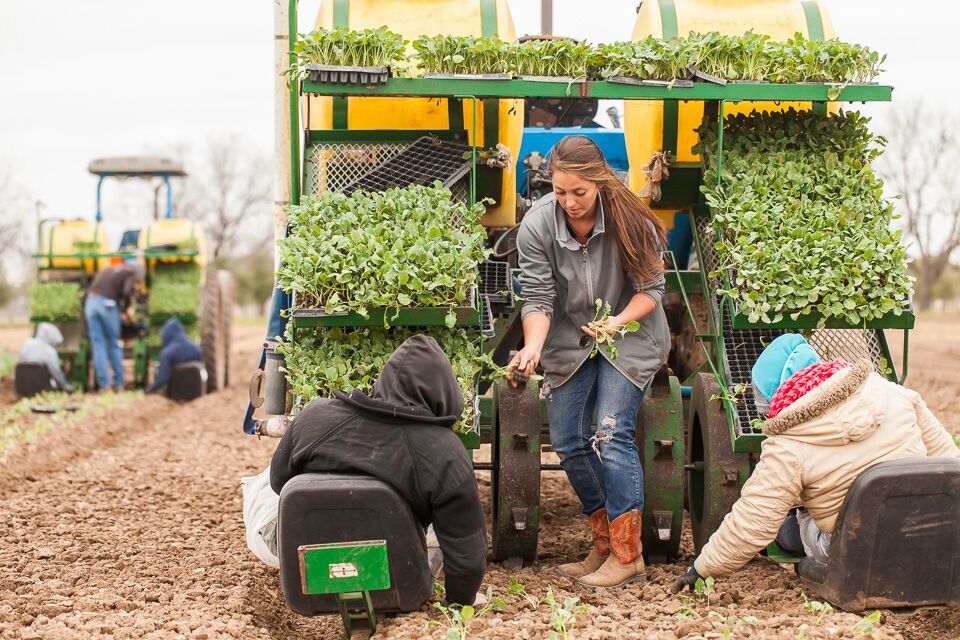 Working on the transplanter. Photo by Scott David Gordon.
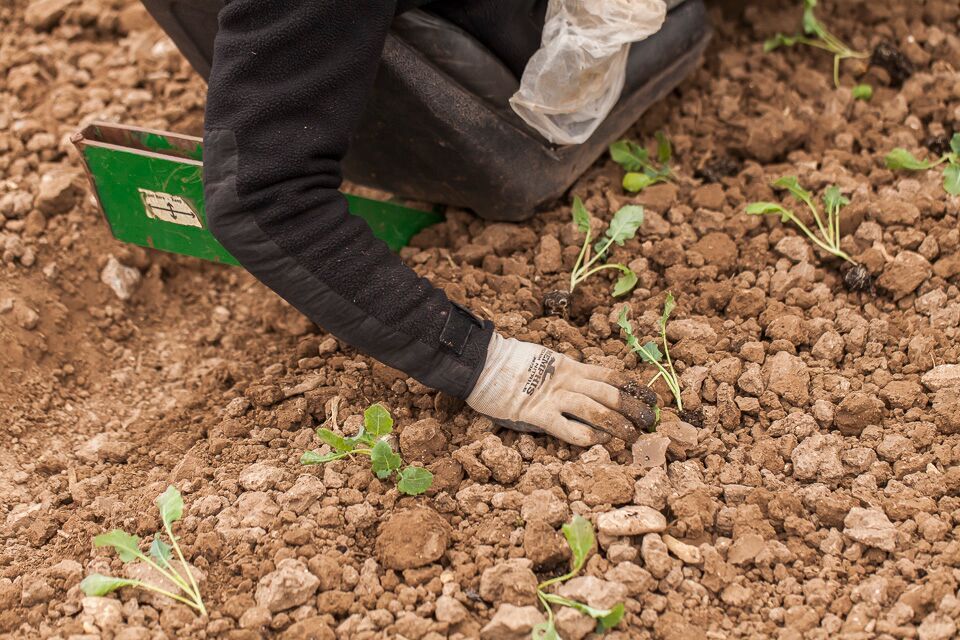 Plugging in the transplants. Photo by Scott David Gordon.
Once the broccoli is transplanted into the ground, it takes about two months for the plants to mature and ready for harvest. Once they are ready though, Vicente and his crew come through and chop off the broccoli heads. They are then sent to Hergotz to be processed for markets, CSA, and wholesale.
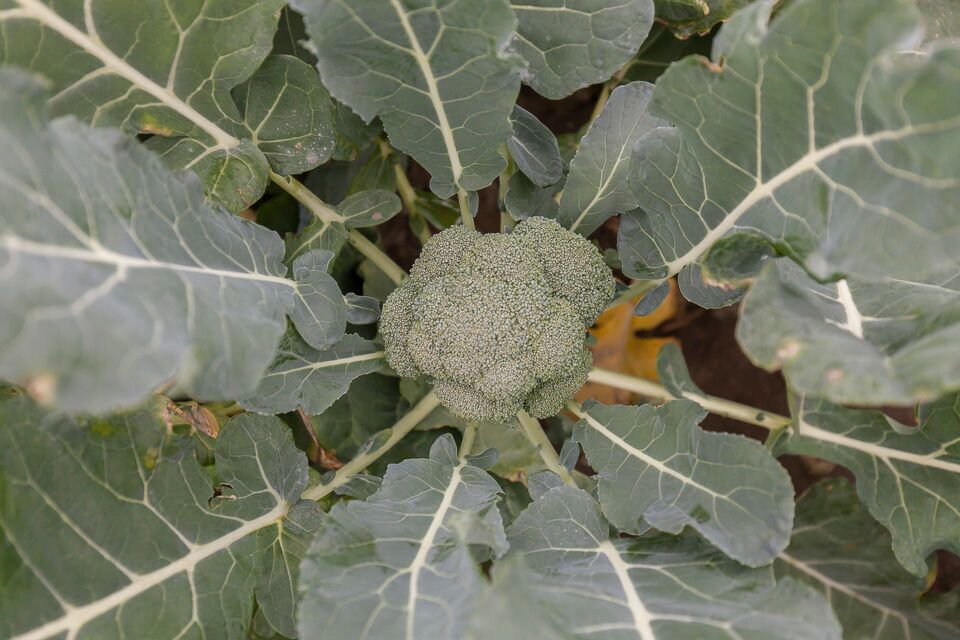 Broccoli growing in the field. Photo by Scott David Gordon.
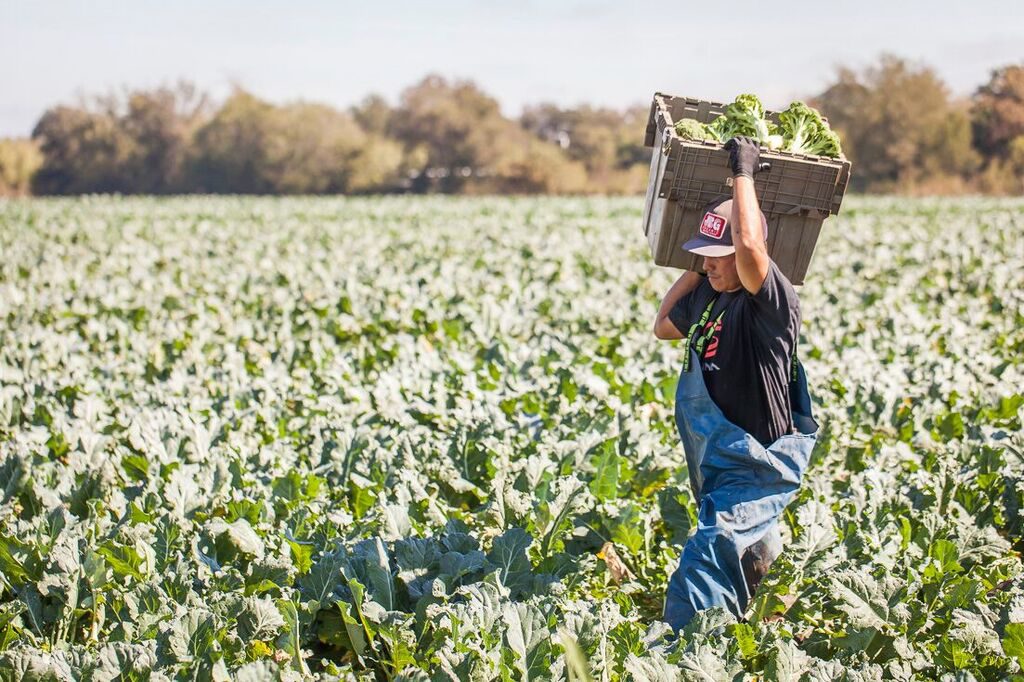 Harvesting. Photo by Scott David Gordon.
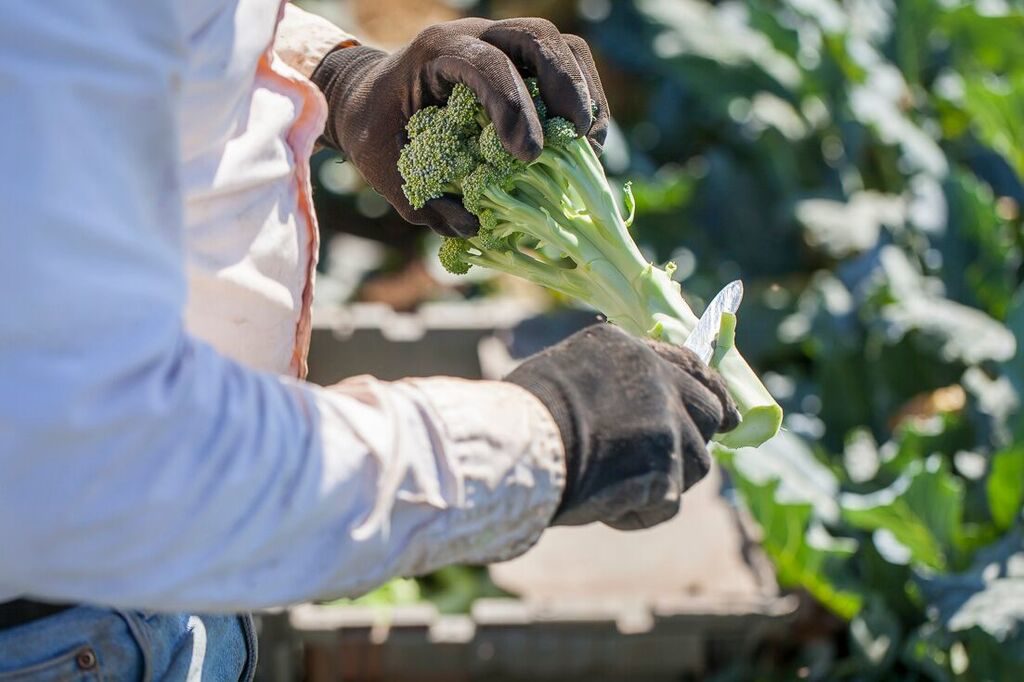 Cleaning up the stalk. Photo by Scott David Gordon.
Broccoli arrives in big white coolers or in IFCOs. We move them swiftly into our coldest cooler as these guys needs to be kept at 32 degrees to retain the highest quality. We shovel fresh ice on the top of the crops twice per day to keep the broccoli super cold! We try to mess with this crop as little as possible as it comes in clean, and is very protected by its outer leaves when it grows. When we are ready to send this crop off to market, we place them back into our big white coolers and dump more ice on them so that they remain cool throughout the day.
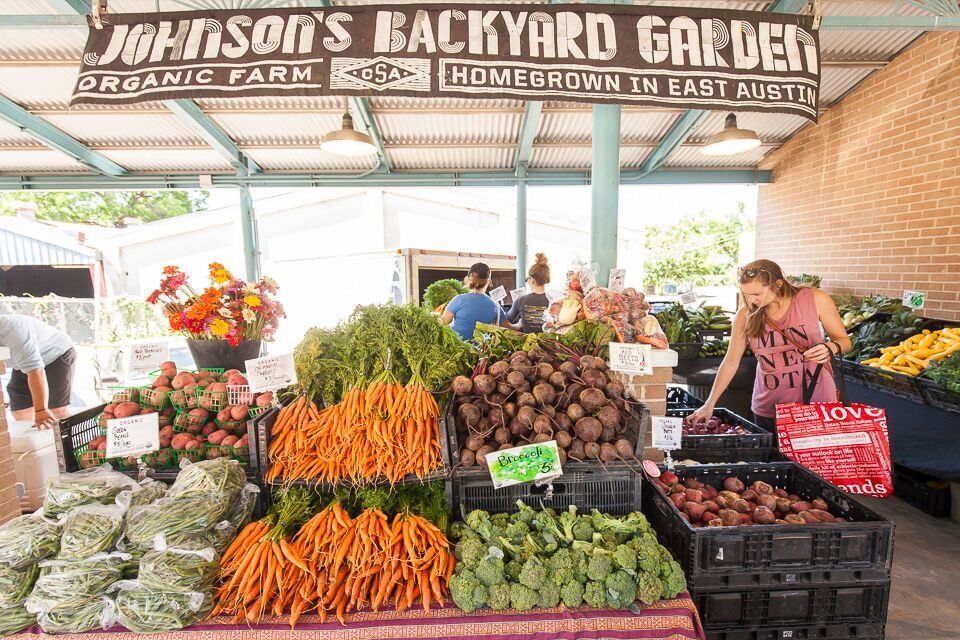 Market broccoli. Photo by Scott David Gordon.
Then they eventually make it to your dinner plate! What an adventure! Come see us at markets this weekend and grab some of this wonderful Fall crop. 'Til next time!