 0 ITEMS IN CART

HAPPY HOLIDAYS FROM JBG
12/24/14 — Aaron
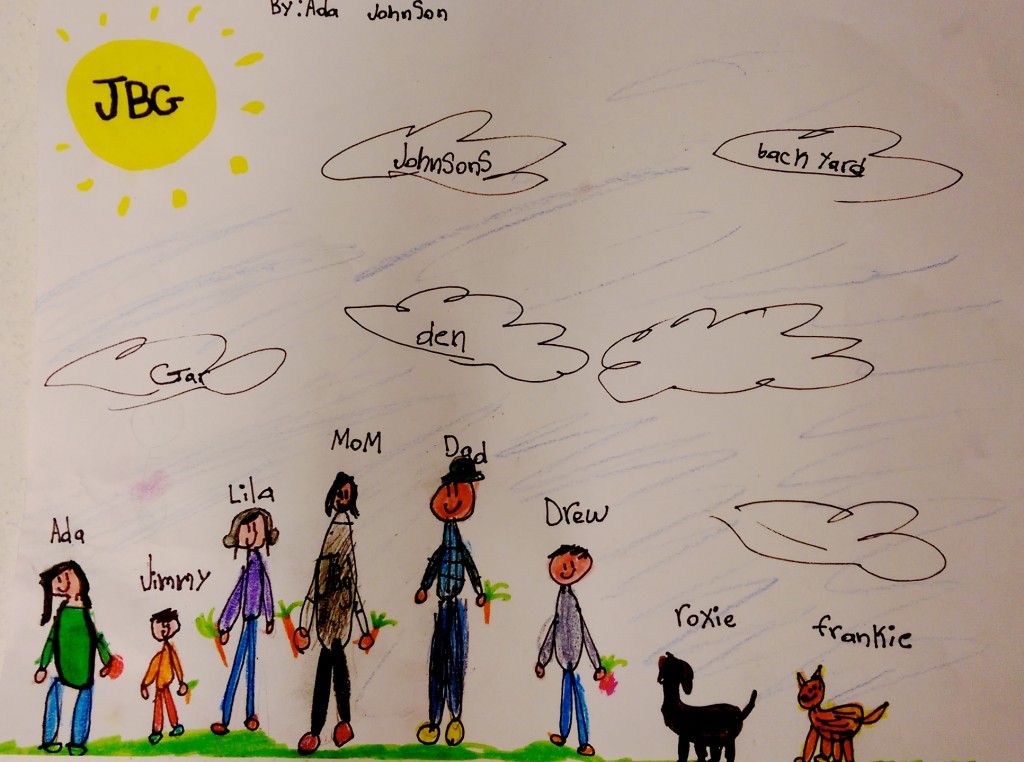 Drawing by Ada Johnson
Right before the holidays, Beth, the kids, and I usually pose for a family portrait. This year, though, we ran out of time. So, I asked Jimmy and Ada if they would draw one instead. They each created their own version of our family, and I love them both! Thank you, Jimmy and Ada - these drawings are even better to me than a photo. All of us - the JBG crew, me, Beth, Lila, Drew, Jimmy, and Ada (and Frankie & Roxie!) - would like to wish everyone happy holidays. We look forward to growing for you in the New Year!
 By Jimmy Johnson
SWEET POTATO TRANSPLANTING
05/18/13 — Farm
 A sweet potato transplant, or slip, goes into the ground. Photo by Scott David Gordon
This past week, we transplanted sweet potatoes, and our photographer, Scott David Gordon, was there to capture the process.
 Christian drives the tractor as Carlos & Veronica plant the sweet potato slips.
 As it moves, the transplanter, disks create furrows in the ground for the sweet potato slips.
 Then, Carlos & Veronica put individual slips on the transplanter's rotating wheel which then places the plant in the ground.
 The wheel of the machine turns & drops individual slips into the furrows.
 A view from above that shows the bins filled with sweet potato slips waiting to go into the ground.
 The beginnings of a row of sweet potato plants.
FROM THE FARMER'S PERSPECTIVE
05/16/13 — Farm
 JBG Tranplants. Photo by Scott David Gordon
The Safe Seed Pledge
You may have read in the news this week about the Supreme Court case that pitted a soybean farmer against Monsanto. The farmer lost the case, adding another win and further legal protections for GMO crops. This made me concerned again about the increase in use of GMO seeds. I also started thinking about the need for clear labeling on products containing GMO ingredients. Having this kind of labeling is the only way that consumers can make an informed choice about the food they eat and vote with their dollars.
Back in 1999, High Mowing Organic Seeds, along with nine other seed companies, took a stand against GMO (genetically modified organism) seeds by creating the following Safe Seed Pledge:
"Agriculture and seeds provide the basis upon which our lives depend. We must protect this foundation as a safe and genetically stable source for future generations. For the benefit of all farmers, gardeners and consumers who want an alternative, we pledge that we do not knowingly buy or sell genetically engineered seeds or plants. The mechanical transfer of genetic material outside of natural reproductive methods and between genera, families or kingdoms poses great biological risks, as well as economic, political and cultural threats. We feel that genetically engineered varieties have been insufficiently tested prior to public release. More research and testing is necessary to further assess the potential risks of genetically engineered seeds. Further, we wish to support agricultural progress that leads to healthier soils, genetically diverse agricultural ecosystems and ultimately healthy people and communities."
The National Organic Program rules and regulations prohibit all certified organic growers from using GMO seeds. However, this is not the primary reason I don't use them. I personally believe we shouldn't be using GMO's, and so I am taking the added step of signing the Safe Seed Pledge. I applaud High Mowing Seeds founder, Tom Stearns, for having the foresight to create such a pledge back in 2001. GMO's were introduced back in the 1990's, and their presence has since grown substantially. Now, the vast majority of US processed foods contain GMOs; however, unlike in Europe, food containing GMOs doesn't have to be labeled in the US. As a diversified vegetable grower, there are lots of things that worry me about the dramatic increase in the use of GMOs, including what I've listed here:
-Many GMO's are engineered to be herbicide resistant (to the weed killer, Roundup, mainly). The reason behind this is, if you make the plant super-resistant to herbicide, you can use a lot more of these chemicals to get rid of weeds and still not kill the crop. This means that more and more harmful chemicals are being put into the soil and damaging the environment. Eventually, the over-use of herbicides could make weeds less resistant, creating a bigger problem in the long run. Also, GMO crops such as field corn, potatoes, sweet corn, and soybeans have been genetically engineered to produce the Bt protein. Bt on its own is an organically-approved way of controlling worms that affect many crops. What's worrying to me is that genetically engineering plants to produce this protein themselves may cause worms to develop an increased resistance to it. This would then render Bt no longer effective for organic and conventional growers alike.
-Use of GMO's creates less plant diversity since seed companies only sell a very limited assortment of GMO variety types. As a farmer, I can't stress how much I love to grow so many different varieties of vegetables. For me, it is exciting that all of this variety exists within each type of crop, and, every year, I look forward to trialing something new at JBG. GMO's threaten to diminish this variety by replacing all of the varieties within a type of plant and with far fewer GMO versions. The thought of this as a farmer makes me both angry and fearful - angry because I do not want to lose the diversity I love and fearful because I know that relying on one variety can lead to catastrophic crop failures. One of the reason we plant so many different varieties of vegetables is to protect against this kind damage.
-As a father, I worry about the health effects of GMOs since these haven't been adequately researched. At a minimum, I feel strongly that, as in Europe, all food that contains GMOs needs to be labeled.
I tend to be a pretty positive, solution-oriented person, and I think that this is what makes me suitable for farming. If there is a problem, I try to solve it. The issue of GMOs, though, feels huge and certainly beyond my individual control. One thing that I think we all can do is to put pressure on the FDA to require food containing GMOs to be labeled. Then, we would at least have the power to make informed choices about the food we purchase. Finally, as a farmer, I want you to know that JBG does not and will not use GMO seed. To do so would both violate the National certified organic rules we follow as well as go against my personal beliefs.
The problem of GMO vegetables hits close to home. For example, GMO vegetables such as sweet corn, summer squash and zucchini, potatoes, soybeans, and radicchio are already in area supermarkets and usually aren't labeled.  You can rest assured, though, that the vegetables you get in your JBG CSA box or from our booth at the farmers market are all GMO-free.
IMAGES FROM THE FIELD
05/16/13 — Farm
 Tomatoes! We're getting closer to the first harvest. Photo by Scott David Gordon
 Tomato plants grow tall. Photo by Scott David Gordon
 A bee finds a farm flower. Photo by Scott David Gordon
 Basil. Photo by Scott David Gordon
 Just-harvested onions. Photo by Scott David Gordon
 Cabbage. Photo by Scott David Gordon
 Cabbage close-up. Photo by Scott David Gordon
 Cabbage. Photo by Scott David Gordon
TURMERIC CHICKEN WITH SPINACH
05/16/13 — Farm

by Louis Singh | dishalicious.com
“This is like medicine,†my Vietnamese mother says as she places this dish in front of me. When feeling ill, she always turns to food, and she swears by the healing powers of turmeric.
And she’s right. A quick search on turmeric reveals tons of information about its anti-inflammatory power, its ability to relieve Rheumatoid arthritis, its cancer-fighting abilities and on and on and on.
Turns out this little rhizome is a healthy powerhouse. But it does come with a few side effects…

IT WILL STAIN THE CRAP OUT OF YOUR FINGERS!
In fact, it’s often used as a dye for clothing and for naturally coloring food. Just be sure to wash your hands after handling it if you don’t want yellow digits all day.
The only other side effect is deliciousness. So you’ll just have to deal with that one. Try out this spin on a classic Vietnamese dish (Gà xà o lăn) adding JBG’s organic spinach.
For about 4 people, you’ll need:

½ red, yellow or white onion, sliced
3 scallions, cut into pieces
4-6 cloves of garlic
¼ cup lemongrass, minced
2 pounds chicken, cut into 1-2†pieces
1 bunch spinach, washed
3 tablespoons turmeric
2 bay leaves
salt & pepper to taste
Here’s how:
-Warm a skillet over medium high heat with about 2 tablespoons of your favorite oil. Add the onion, scallions, garlic and lemongrass. Season with a pinch of salt & pepper and sauté until fragrant and beginning to turn golden brown. About 3-5 minutes.
-Add in the chicken and season again with a little salt & pepper. Saute with the aromatics until almost cooked through, about 5-7 minutes.
-Add in the turmeric and bay leaf, stir well to coat.
-Add the spinach and stir well to combine. Simmer it all together until the chicken is done and the spinach is wilted, another 5 minutes or so.
And that’s it. Traditionally it’s served with steamed rice, but you could have it with quinoa or couscous. Add in fresh cherry tomatoes as pictured above, try swiss chard instead of spinach, or add some fresh chilies for a kick. Use this technique and what’s in your fridge to make your own recipes. Get cooking!
Send us your cooking questions and get answers. info@dishalicious.com
COOKING BY THE BOOK: JERUSALEM
05/15/13 — Farm
 Use the chard in your CSA share to create Chard Fritters from the Jerusalem cookbook. Photo by Scott David Gordon
Review by Meredith Bethune
The cover of Jerusalem by Yotam Ottolenghi and Sami Tamimi depicts yellow egg yolks and fiery tomatoes served over a bed of ground lamb in a cast iron skillet. The vibrant colors and rustic presentation artfully represent this book that just won the International Association of Culinary
Professionals Cookbook of the Year Award. Their vegetable-centric and exotic recipes are suitable for all seasons, and they'll definitely inspire any farmers market shopper to cook.
Ottolenghi grew up in the Jewish quarter of Jerusalem, and Tamimi was born in the Arab eastern section. They met as adults in London, and now Tamimi is partner and head chef at Ottolenghi's popular restaurants. Jerusalem is well-known for its religious divisions, but the authors show that residents are actually united by their love of certain dishes. Although they might quibble over the size of the vegetables (should they be finely diced or in rustic chunks?), everyone eats fattoush-- a refreshing summer salad of cucumbers, mint, and tomatoes. An entire section of the book is dedicated to hummus, the city's most beloved dish. Several mouth-watering photos depict the familiar chickpea dip dusted with red sumac and cradling pools of golden olive oil and piles of pines nuts.
The captivating photography in Jerusalem reaches beyond food. Fascinating images of modern urban life appear next to unexpected recipes like Roasted Sweet Potatoes and Fresh Figs and Roasted Butternut Squash and Red Onion with Tahini and Za'atar .
Combined with the author's captivating writing style, these photos communicate a sense of lushness and longing. Jerusalem might inspire in you a yearning for the city that you never knew you had.
Recipes from Jerusalem from around the web:
Fattoush
Roasted Sweet Potatoes & Fresh Figs
Swiss Chard Fritters
CSA BOX WEEK OF MAY 13TH
05/13/13 — Scott
 CSA Box Week of May 13th
Fennel,
Lettuce,
Basil,
Kohlrabi,
Chard,
Spinach,
Purple Top Turnips,
Cabbage,
Onions,
Carrots,
Cauliflower or Broccoli